Home eBooks Open Access Journals
Home
Subscribe: Members Articles RSS Feed Get New Issue Alerts
Browse Archive

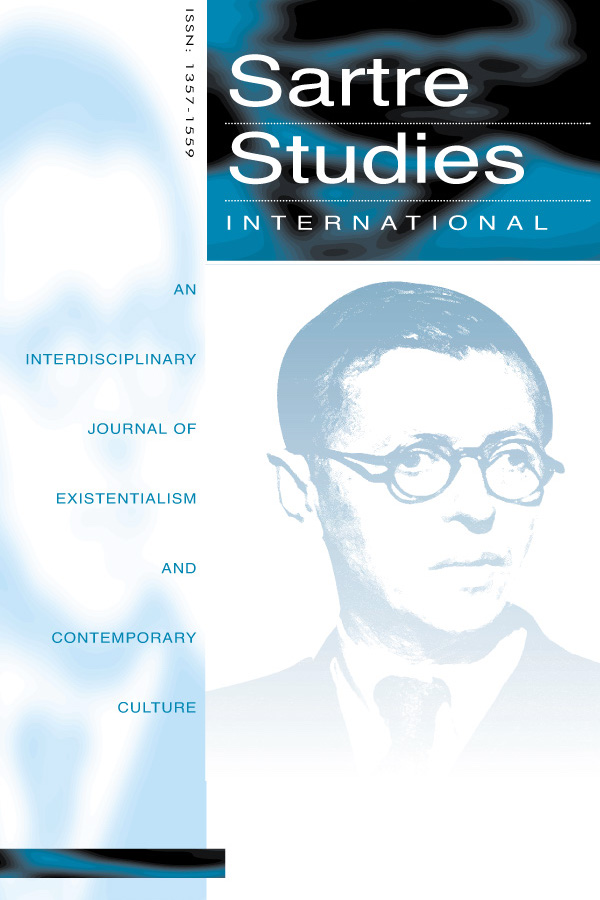
Sartre Studies International

An Interdisciplinary Journal of Existentialism and Contemporary Culture

ISSN: 1357-1559 (print) • ISSN: 1558-5476 (online) • 2 issues per year

Volume 9 Issue 2

Editorial

We begin this issue with a Symposium entitled “Sartre and Terror.” It is introduced by Kenneth Anderson and it opens with a translation by Elizabeth Bowman of Sartre’s commentary on the 1972 Munich massacre. She has prefaced it with a summary of events. Next Ronald Aronson focuses on the events of 9/11 and distinguishes between permissible and destructive violence.

Introduction

Following is a minimally edited transcript of a session on Sartre and terrorism from the North American Sartre Society meeting at Loyola University in New Orleans, March 2002. I organized the session as a response to the events of September 11, 2001. Initially at a loss to comprehend what occurred, I decided that this was exactly the kind of event that called for philosophical consideration. The attacks stunned me both in terms of the numbers of dead (I remember that morning hearing estimates of a possible 20,000 dead, now deter- mined to be just over 2,700) and perhaps even more because of the means used and the symbolic and cultural significance of the targets.

Sartre on Munich 1972

Elizabeth A. Bowman

The first internationally staged “terrorist” event—the Palestinian kidnapping of Israeli athletes—occurred in Munich Germany during the 1972 Summer Olympics. Sartre’s article “About Munich” concerns this event.

The New Orleans Session—March 2002

Ronald AronsonRonald E. SantoniRobert Stone

I would like to shift the question. I don’t think the important question is what Sartre would say after September 11, but rather, “What should we say about Sartre after September 11?”

Sartre: Intellectual of the Twentieth Century

David Drake

There is little doubt that Sartre would have a strong claim to the title of greatest French intellectual of the twentieth century, but what exactly does “intellectual” mean in relation to Sartre? It is beyond both the compass and purpose of this paper to conduct a comprehensive analysis of the debate around the definition and role of “the intellectual.” I will simply dip a toe into these troubled waters by focusing on two dimensions of the term intellectual, namely what I call a socio-professional definition and a political definition.

Sartre, Derrida and Commitment: The Case of Algeria

Bruce Baugh

Let me start with an apparent aside. In the midst of his dialectical demolition of Foucault’s Histoire de la folie, in “Cogito et histoire de la folie,” Derrida argues that although Foucault wants to do an archeology of madness’s silence, an archeo-logy is a logically ordered work (465), and that even though Foucault wants to protest against reason’s sequestration of madness, “reason in the classical age” can only be brought before the tribunal of Reason in general (466), which could then rule on the unreasonableness of classical reason.

Fanon and Sartre 50 Years Later: To Retain or Reject the Concept of Race

Kathryn T. Gines

Jean-Paul Sartre’s “Orphée Noir” was first published in 1948 as the preface to Leopold Senghor’s Anthologie de la nouvelle poésie nègre at malgache de langue française, a classic anthology of Negritude poetry.1 Frantz Fanon replied to Sartre with “L’expérience vécue du Noir” published in Esprit in May of 1951.2 This essay later became the fifth chapter of Fanon’s Peau noire, masques blancs, published in 1952.3 In Black Skin, White Masks, Fanon is not only confronting Sartre’s analysis of Negritude in “Black Orpheus,” he is also meeting head-on Sartre’s analysis of race as it pertains to the Negro in “Black Orpheus” and as it pertains to the Jew in Anti-Semite and Jew. Towards that end, Fanon claims that Sartre’s arguments about the Jewish experience are incompatible with the “lived-experience” of the Negro.

Sartre's Wagers: Humanism, Solidarity, Liberation

Matthew C. Ally

Are these papers about intellectuals? Or are they about racism and colonialism? Are they about Sartre or Fanon or Derrida? “Risks of Engagement” is the title of the panel for which these papers were originally presented. We should think about that. Bruce Baugh quotes Simon Critchley: “Derrida can give no account, in terms of his own philosophical positions, of why he made just the ‘gamble’ he did.” No he cannot, not in terms of his own philosophical positions, nor in terms of anyone else’s.

Book Reviews

Derek K. HeymanBeata StawarskaThomas R. FlynnDavid Detmer

Steven Laycock, Nothingness and Emptiness: A Buddhist Engagement with the Ontology of Jean-Paul Sartre. (Albany: State University of New York Press, 2001), 240pp. ISBN 0791449106, $21.95 (paper). Review by Derek K. Heyman

Stephen Priest, The Subject in Question: Sartre’s Critique of Husserl in the Transcendence of the Ego. New York: Routledge, 2000, 192 pp. ISBN 041521369X, $105. Review by Beata Stawarska

Ronald Aronson, Camus and Sartre: The Story of Friendship and the Quarrel that Ended It. Chicago: University of Chicago Press, 2004, 248 pp. ISBN 0226027691, $32.50. Review by Thomas R. Flynn

Ronald E. Santoni, Sartre on Violence: Curiously Ambivalent. University Park, PA: The Pennsylvania State University Press, 2003, 179pp. ISBN 0-271-02300-7, $35.00. Review by David Detmer

Contributors

Notes on contributors