Home eBooks Open Access Journals
Home
Subscribe: Members Articles RSS Feed Get New Issue Alerts
Browse Archive

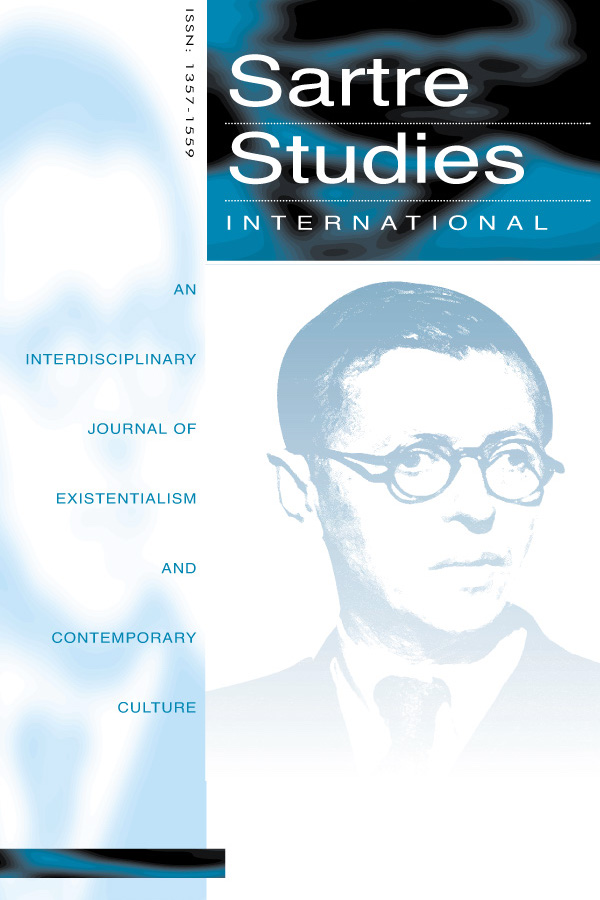
Sartre Studies International

An Interdisciplinary Journal of Existentialism and Contemporary Culture

ISSN: 1357-1559 (print) • ISSN: 1558-5476 (online) • 2 issues per year

Volume 26 Issue 2

Editorial

John IrelandConstance Mui

The fortieth anniversary of Sartre's death, on April 15 of this year, found much of the world in lockdown in response to a new virus, Covid-19, which has changed humanity's situation on this planet in ways we will be struggling to elucidate for years to come. In these unprecedented circumstances, Sartre's thought has been an obvious resource to help us understand the impact and ramifications of this pandemic. The virus has been an unsparing indicator in itself of social injustice, unmasking the pious platitudes of our advanced, modern democracies. In the United States in particular, the reality is truly ugly. Covid-19 has shed pitiless light on the disparity between affluent white communities, able to “shelter in place” and avoid putting their members at risk of infection, and less affluent black and brown districts, where workers on subsistence salaries, often without health-care benefits, have been forced to work in unsafe conditions, with terrible consequences for them and their families. Living in the “richest” country on earth, we can imagine only too easily Sartre's vitriolic assessment of America in its present crisis. And it is just as easy to imagine the fervor with which he would have embraced the Black Lives Matter protests that erupted all over the world, provoked by the 8 minute 46 second video clip that showed the matter-of-fact murder by asphyxiation of George Floyd by white police officers in Minneapolis.

Incarnation, Alienation, and Emancipation

A Sartrean Analysis of Filmic Violence

Daniel Sullivan Abstract

In Critique of Dialectical Reason Vol. 2, Sartre analyzes a boxing match in light of a typology of violence. He suggests that individual conflicts incarnate broader forces of structural violence. He distinguishes between incidents of incarnating violence in terms of their broader social effects, as either alienated – commoditized or “mystified” and rendered illicit – or emancipatory – embedded in a collectively willed political project. This conceptualization is used to analyze two films, Aronofsky's The Wrestler and McQueen's Hunger. The Wrestler is an excellent meditation on the ways in which the violence of the oppressed is alienated in contemporary U.S. culture, whereas Hunger gestures toward the possibility of emancipatory violence. The article finally considers the act of watching these films as a Sartrean incarnation of violence.

L'humanisme et la question du langage

Sartre lecteur de Brice Parain

Hiroaki Seki Abstract

In this paper we examine the dialogue between Sartre and one of his contemporaries, the philosopher of language, Brice Parain. First, after clarifying what is common and different in their backgrounds, we will see that Sartre and Parain share a common belief that language itself has taken ill, as a result of the First World War, an illness for which both feel a need to find a remedy. Secondly, we will show how Sartre's reading of Parain allowed him to construct a theory of language that is consistent with his own humanism and the principles of committed literature. Finally, we will examine the influence of the religious dimension of Parain's argument on Sartre's theory of authorship.

Résumé

Cet article examine un dialogue important mais peu étudié entre Sartre et le philosophe du langage Brice Parain. Les deux écrivains constatent un mal du langage, issu de la Grande Guerre de 1914-18 et de ses traumatismes que les mots proférés par les survivants sont incapables de prendre en charge. Dans ce monde « inhumain », où trouver un remède ? Pour Parain et Sartre le retour à n'importe quel humanisme implique une réflexion sur le langage. A travers sa lecture de Parain et ce qu'il propose, Sartre repense les bases de sa propre conception du langage d'une manière qui lui permet de développer son propre humanisme et les principes de la littérature engagée. Mais la dimension religieuse de l'argumentation de Parain, écartée par Sartre, laisse-t-elle des traces sur la conception sartrienne de l'auteur ?

Being-for-itself and the Ontological Structure

Can Being-for-itself Avoid Bad Faith?

Ronald E. Santoni Abstract

In this paper, I pay tribute to Jonathan Webber, one of the most dependable interpreters among recent Sartre scholars. I do so by challenging both him and Sartre on an issue that has long frustrated my work on Sartre. In short, Sartre contends that the For-itself's desire to be (and to pursue) Being-in-itself-for-itself (i.e., God) is in bad faith. This raises two issues: (1) Is this desire to be ens causa sui part of the ontological structure of the For-itself? (2) If so, is bad faith an essential part of the human being? I contend that the desire to be the In-itself-for-itself is, on Sartre's premises, part of the ontological structure of an existing human being (pour-soi). As our original flight from freedom and “fundamental project,” this constitutes bad faith's “coming into the world,” and remains part of Being-for-itself's “natural” disposition to bad faith.

From Perception to Action

Sartre's Practical Phenomenology

Blake D. Scott Abstract

This paper re-examines the well-known problem of how it is possible to have an “intuition of absences” in Sartre's example of Pierre. I argue that this problem is symptomatic of an overly theoretical interpretation of Sartre's use of intentionality. First, I review Husserl's notion of evidence within his phenomenology. Next, I introduce Sartre's Pierre example and highlight some difficulties with interpreting it as a problem of perception. By focusing on Sartre's notion of the project, I argue instead that the problem is better understood at the level of action. In support of this interpretation, I conclude with a brief comparison to the early work of Paul Ricoeur. By borrowing some of Ricoeur's phenomenological vocabulary tailored to action, I reinterpret Sartre's example as a practical problem.

Your Past Comes Back to Haunt You

Sartre on Pure Reflection in Response to Husserl & Levinas

Curtis Sommerlatte Abstract

This paper examines how Sartre's early phenomenological works were influenced by Emmanuel Levinas's The Theory of Intuition in Husserl's Phenomenology. Sartre embraced two key aspects of Levinas's interpretation of Husserl: 1) that phenomenology is an ontological philosophy whose foundation is the doctrine of intentionality; and, 2) that consciousness's being consists in intentionality, which entails that consciousness is non-substantial as well as pre-reflectively or non-thetically aware of itself. In addition to adopting these views, Sartre also became gripped by a methodological problem raised by Levinas. Namely, phenomenology reflects on consciousness, yet reflection modifies the consciousness it reflects on. I argue that Sartre responds to this problem by developing two of Levinas's ideas: that reflection is a motivated act and that reflection must adequately grasp consciousness's temporality.

Book Reviews

Sarah HortonAdrian van den Hoven

Daniel O'Shiel, Sartre and Magic: Being, Emotion, and Philosophy (London: Bloomsbury, 2019), 198 pp., $79.80, ISBN: 978-1-3500-7766-9 (hardback).

Brill's Companion to Camus: Camus among the Philosophers. Eds. Matthew Sharpe, Maciej Kałuża, and Peter Francev. (Leiden/Boston: Brill, 2020), 488 pp., $180, ISBN: 9789004401747 (hardback)

Yan Hamel, En Randonnée avec Simone de Beauvoir. Boréal, Montréal, Canada, 2020. Can $25,95.