Home eBooks Open Access Journals
Home
Subscribe: Members Articles RSS Feed Get New Issue Alerts
Browse Archive

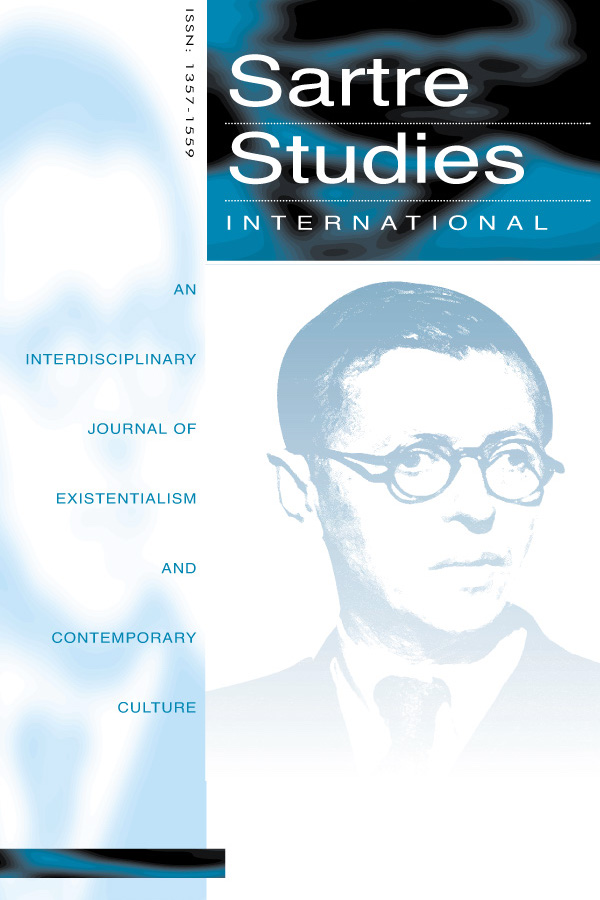
Sartre Studies International

An Interdisciplinary Journal of Existentialism and Contemporary Culture

ISSN: 1357-1559 (print) • ISSN: 1558-5476 (online) • 2 issues per year

Volume 30 Issue 1

Editorial

This issue contains a symposium on Jonathan Webber's recent Rethinking Existentialism, bookended by two articles. The first of those two articles is a translation (by the author herself and John Gillespie) of Annie Cohen-Solal's highly significant article in Le Monde, ‘Who's Still Afraid of Sartre?’, which gives us a flavour of her much more extensive keynote, with the same title, at last year's meeting of the UK Sartre Society. It is an exploration, by the woman who not only wrote (among many other things) the first biography of Sartre, but has been able to observe French politics and society for decades from the position of a semi-outsider, born in Algeria to a Jewish family, of why Sartre remains such a divisive figure. The other is ‘The Beauty and the Beast: Reading La Nausée through Derrida's L'animal que donc je suis’, by Luca Tripaldelli. As the subtitle indicates, the author puts these two works into a delicate conversation, arguing that the Sartre of La Nausée need not have ended up in humanism and a binary opposition between humans and animals.

Who's Still Afraid of Sartre?

Annie Cohen-SolalJohn H Gillespie

Annie Cohen-Solal, Sartre's biographer and author, was one of the keynote speakers at last year's UK Sartre Society Conference at La Maison française in Oxford. The title of her talk echoed that of a key article she published in Le Monde on 12/13 March 2023, ‘Qui a encore peur de Sartre?’, which brilliantly characterises Sartre's position in France and in the world. The article is translated in full below.

Jon Webber's

Introduction to the Symposium

Matthew Eshleman

The three articles and commentary that follow began as talks for a book symposium dedicated to Jon Webber's monograph Rethinking Existentialism. The talks were given for a plenary session at the United Kingdom Sartre Society meeting, held at the Maison Française d'Oxford on 3 July 2023. Organised to honour the excellence of Webber's work on Sartre, the Symposium aimed to call attention to the importance of his monograph. Since Rethinking Existentialism centrally addresses Jean-Paul Sartre, Simone de Beauvoir and Frantz Fanon, the division of labour was straightforward. Matt Eshleman addresses Webber's treatment of Sartre, Kate Kirkpatrick his treatment of Beauvoir and Komarine Romdenh-Romluc his treatment of Fanon. For those who have not read Rethinking Existentialism a brief synopsis follows.

Towards Two Accounts of Sartrean Authenticity

Matthew Eshleman Abstract

Motivated by Jonathan Webber's recent work, this article addresses what I call ‘the normative bridge problem’ in the early work of Jean-Paul Sartre: What justifies the move from an agent explicitly recognising and affirming her freedom to an obligation to respect the freedom of others? Many sympathetic Sartre commentators have argued that Sartre lacks resources to justify this obligation (Anderson, Heter, Webber) and, hence, that Sartre fails to traverse the normative bridge. This article hypothesizes that Sartre does not need to explicitly justify the bridge obligation. In correctly grasping one's metaphysical nature, a Sartrean agent cannot fail to realise that the affirmation of the freedom of others cannot but follow from the affirmation of one's own freedom. I test the hypothesis by sketching two competing interpretations of authenticity and try to show that only under one interpretation can one see why the normative bridge amounts to a theoretical illusion.

Rethinking Beauvoir

Kate Kirkpatrick Abstract

I have been invited to respond to Rethinking Existentialism's engagement with the work of Simone de Beauvoir, and I do so in three parts. First, I introduce Webber's Beauvoir, moral theorist, and raise some textual and conceptual objections to his argument for a ‘categorical imperative for authenticity’ in Chapter 10. Second, I turn to historical and conceptual challenges to Webber's definition of existentialism, including meta-philosophical questions about his use of literature in general and Beauvoir's novel She Came to Stay in particular. Finally, I conclude with a trio of broad questions relating to what I will call the ‘missing materiality’ in Webber's Beauvoir: Where's the ambiguity? Where's the tragedy? Where's the tension?

Black Orpheus, Fanon and the Negritude Movement

Komarine Romdenh-Romluc Abstract

In Rethinking Existentialism, Jonathan Webber examines Fanon's engagement with the Negritude movement, focusing on his discussion in Black Skin, White Masks. A portion of Fanon's text discusses an interpretation of the movement advanced by Sartre in his essay ‘Black Orpheus’. Here, I raise some difficulties for what I will call Webber's ‘black agency’ reading of Fanon, before presenting an alternative. I argue that Fanon accepted certain important Negritude ideas, particularly Césaire's conception of a therapeutic method called the nekyia, and that this is crucial to understanding Fanon's response to Sartre.

Rethinking Existentialism

A Response to Eshleman, Kirkpatrick and Romdenh-Romluc

Jonathan Webber Abstract

This article is a response to critiques of my book Rethinking Existentialism in this symposium. It begins with a reflection on the nature of this discussion. Then it reformulates Eshleman's ‘bridge problem’ to defend my view that eudaimonist arguments cannot establish that we ought to respect freedom. Next, it shows how my interpretation of Beauvoir's argument for authenticity can incorporate Kirkpatrick's reading of Beauvoir's ethics. Then it uses Romdenh-Romluc's description of Fanon's therapeutic methodology to present a comparative reading of Fanon and Sartre, followed by an argument that Romdenh-Romluc's reading of Fanon can be incorporated into my interpretation to the benefit of both. The penultimate section incorporates Beauvoir's theory of femininity into my account of her theory of gender sedimentation. The final section considers how Eshleman's emphasis on social interdependence might enrich Sartre's picture of authenticity. The article closes with brief comments on the value of reading these texts together.

The Beauty and the Beast

Reading through Derrida's

Luca Tripaldelli Abstract

This essay analyses Sartre's Nausea as a site of posthumanist revolt against the more humanistic sentiments of Being and Nothingness. Placing it alongside Derrida's exploration of animality and the human in The Animal That Therefore I Am, it examines the profusion of ‘bestial references’ in Sartre's text, and how the text promotes a postmodern openness to the multiplicity of existence by viewing the alterity of animals in a positive light.

Book Reviews

Alfred BetschartAdrian van den HovenNik Farrell FoxLuca Tripaldelli

Elizabeth A. Bowman and Robert V. Stone, Reading Sartre's Second Ethics: Morality, History, and Integral Humanity, ed. Matthew C. Ally (Lanham, MD: Lexington Books, 2023), xxv +397 pp., $125.00 (hardback), ISBN: 9781793646514, $50.00 (EPUB), ISBN: 9781793646521

Catalano, Joseph, ed. An Abridged Edition of Jean-Paul Sartre's, The Family Idiot,: Gustave Flaubert, 1821-–1857, An Abridged Edition (Chicago: The University of Chicago Press, 2023), 292 pp. ISBN: 13978-0-226-8232-x

Marcel Siegler, Needful Structures: The Dialectics of Action, Technology, and Society in Sartre's Later Philosophy (Bielefeld: Transcript, 2023), 209 pp., $37.56 (paperback), ISBN: 978-3-8376-6282-5

Jennifer Anna Gosetti-Ferencei, On Being and Becoming: An Existentialist Approach to Life (New York: Oxford University Press, 2021), $18.95 (hardback), ISBN: 978-0-19-091365-6

Peg Brand Weiser (ed.), Camus's The Plague: Philosophical Perspectives (Oxford: Oxford University Press, 2023), 256 pp., £77.00 (hardback), ISBN: 978-0197599327, £16.99 (paperback), ISBN: 978-0197599334