Home eBooks Open Access Journals
Home
Subscribe: Members Articles RSS Feed Get New Issue Alerts
Browse Archive

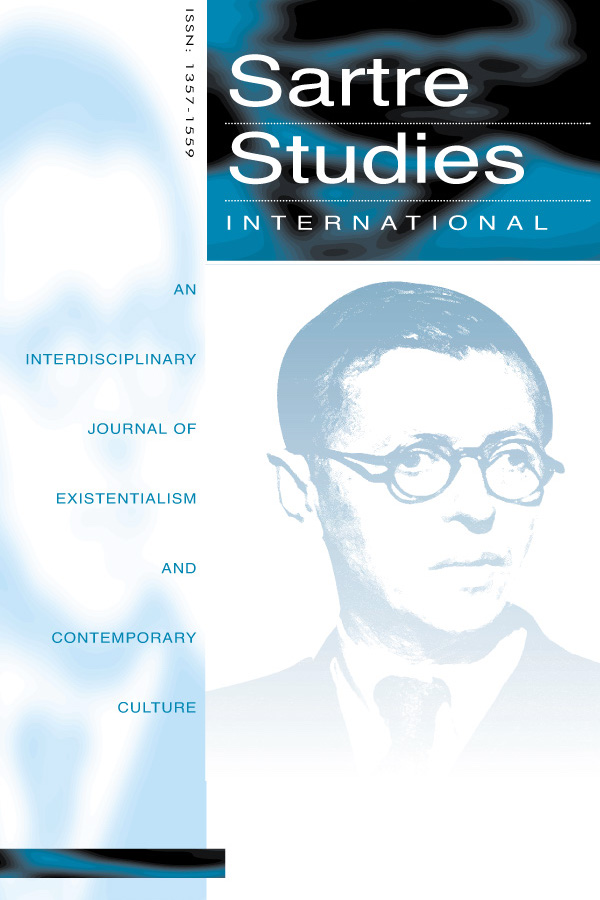
Sartre Studies International

An Interdisciplinary Journal of Existentialism and Contemporary Culture

ISSN: 1357-1559 (print) • ISSN: 1558-5476 (online) • 2 issues per year

Volume 15 Issue 2

Nausea, Melancholy and the Internal Negation of the Past

Cam Clayton

In this paper, I argue that temporality, as described in Being and Nothingness, is a central theme in Nausea. In the first section I make the point that one of Sartre's guiding concerns at the time of publishing Nausea is temporality and the temporal nature of freedom. In the second section, the theme of melancholy and its relationship to temporality is explored. The third section explores Sartre's use of this image of being taken 'from behind'. I use this temporal imagery as a guide for interpreting Roquentin's reaction to the rape and murder of Lucienne. By interpreting this scene by way of the temporality of Being and Nothingness, we can duly recognize the early Sartre's concern with temporality, understand the melancholia that arises because of the 'internal' negation of the past, and give a more satisfying account of a scene which is often ignored in the secondary literature.

Untrue to One's Own Self: Sartre's The Transcendence of the Ego

Iker Garcia

In this paper, I elicit a number of ways in which, according to the Sartre of The Transcendence of the Ego, we can miss the truth about our own self or, more simply, about ourselves. In order to do that, I consider what I call “statements about one's own self,” that is, statements of the form “I ...” where the predicate of the statement is meant to express things that are true of what is evidently given in reflection. I argue that, although statements about one's own self can, according to Sartre, be true on final philosophical analysis, there are at least three senses in which statements about one's own self can or do miss the truth, even when they are (by hypothesis) true. How they miss the truth depends on the different level of philosophical analysis at which we take Sartre to be working.

Thinking Things: Heidegger, Sartre, Nancy

Marie-Eve Morin

This paper compares Sartre's and Nancy's experience of the plurality of beings. After briefly discussing why Heidegger cannot provide such an experience, it analyzes the relation between the in-itself and for-itself in Sartre and between bodies and sense in Nancy in order to ask how this experience can be nauseating for Sartre, but meaningful for Nancy. First, it shows that the articulation of Being into beings is only a coat of veneer for Sartre while for Nancy Being is necessarily plural. Then, it contrasts Nausea as an experience without language with Nancy's thinking of the excription of sense in the thing.

Sartre & the Other: Conflict, Conversion, Language & the We

Gavin Rae

Sartre's phenomenological ontology discloses that understanding consciousness and its mode of being requires an analysis of its relation with other consciousnesses. The primordial manner in which the Other relates to consciousness is through the look. Sartre claims that consciousness tends to adopt a pre-reflective fundamental project that leads it to view the Other as a threat to its pure subjective freedom. This creates a conflictual social relation in which each consciousness tries to objectify the Other to maintain its subjective freedom. But Sartre also notes that consciousnesses can establish a social relation called the “we” in which each consciousness is a free subject. While certain commentators have noted that communication allows each consciousness to learn that the Other is not simply a threatening object but another subject, communication can only play this positive role if both consciousnesses have undergone a specific process called conversion. Only conversion brings consciousness to recognise, respect, and affirm the Other's practical freedom in the way necessary to create a we-relation. To support my argument, I spend significant time outlining what conversion and the social relations created post-conversion entail.

Sartre's Theater of Resistance: Les Mouches and the Deadlock of Collective Responsibility

Andrew Ryder

Sartre's play Les Mouches (The Flies), first performed in 1943 under German occupation, has long been controversial. While intended to encourage resistance against the Nazis, its approval by the censor indicates that the regime did not recognize the play as a threat. Further, its apparently violent and solitary themes have been read as irresponsible or apolitical. For these reasons, the play has been characterized as ambiguous or worse. Sartre himself later saw it as overemphasizing individual autonomy, and in the view of one critic, it conveys an “existentialist fascism.” In response to this reading, it is necessary to attend to the elements of the play that already emphasize duty to society. From this perspective, the play can be seen as anticipating the concern with collective responsibility usually associated with the later Sartre of the 1960s. More than this, the play's apparent “ambiguity” can be found to exemplify a didacticism that is much more complex than sometimes attributed to Sartre. It is not only an exhortation about ethical responsibility, but also a performance of the difficulties attendant to that duty.

Book Reviews

Matthew C. EshlemanDavid LethbridgeJ. C. BerendzenT Storm Heter

T Storm Heter, Sartre’s Ethics of Engagement Review by Matthew C. Eshleman

Jean-Paul Sartre, The Aftermath of War Review by David Lethbridge

David Sherman, Sartre and Adorno: The Dialectics of Subjectivity Review by J. C. Berendzen

Yiwei Zheng, Ontology and Ethics in Sartre’s Early Philosophy Review by T Storm Heter

Abstracts

Abstracts