 Get New Issue Alerts
Browse Archive
- Vol 31 Issue 2
- Vol 31 Issue 1
- Vol 30 Issue 2
- Vol 30 Issue 1
- Vol 29 Issue 2
- Vol 29 Issue 1
- Vol 28 Issue 2
- Vol 28 Issue 1
- Vol 27 Issue 2
- Vol 27 Issue 1
- Vol 26 Issue 2
- Vol 26 Issue 1
- Vol 25 Issue 2
- Vol 25 Issue 1
- Vol 24 Issue 2
- Vol 24 Issue 1
- Vol 23 Issue 2
- Vol 23 Issue 1
- Vol 22 Issue 2
- Vol 22 Issue 1
- Vol 21 Issue 2
- Vol 21 Issue 1
- Vol 20 Issue 2
- Vol 20 Issue 1
- Vol 19 Issue 2
- Vol 19 Issue 1
- Vol 18 Issue 2
- Vol 18 Issue 1
- Vol 17 Issue 2
- Vol 17 Issue 1
- Vol 16 Issue 2
- Vol 16 Issue 1
- Vol 15 Issue 2
- Vol 15 Issue 1
- Vol 14 Issue 2
- Vol 14 Issue 1
- Vol 13 Issue 2
- Vol 13 Issue 1
- Vol 12 Issue 2
- Vol 12 Issue 1
- Vol 11 Issue 1
- Vol 10 Issue 2
- Vol 10 Issue 1
- Vol 9 Issue 2
- Vol 9 Issue 1
- Vol 8 Issue 2
- Vol 8 Issue 1
- Vol 7 Issue 2
- Vol 7 Issue 1
- Vol 6 Issue 2
- Vol 6 Issue 1
- Vol 5 Issue 2
- Vol 5 Issue 1
- Vol 4 Issue 2
- Vol 4 Issue 1
- Vol 3 Issue 2
- Vol 3 Issue 1
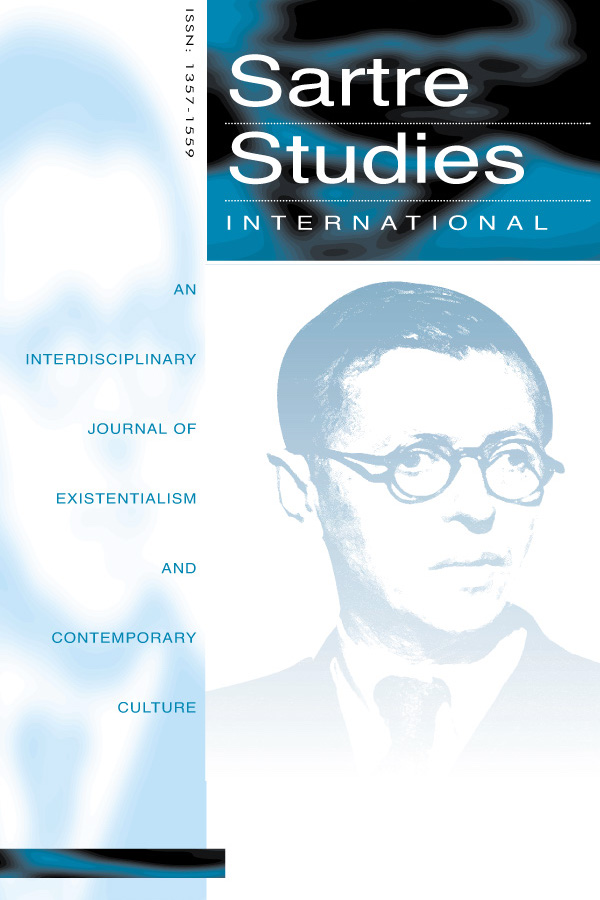
Sartre Studies International
An Interdisciplinary Journal of Existentialism and Contemporary Culture
ISSN: 1357-1559 (print) • ISSN: 1558-5476 (online) • 2 issues per year
Volume 19 Issue 1
Get 35% discount when you checkout 3 or more PDF articles.
Drives as Original Facticity
By introducing 'drives' into a Sartrean framework, 'being-in-itself' is interpreted as 'Nature as such', wherein instincts dominate. Being-for-itself, on the contrary, has an ontological nature diametrically opposed to this former - indeed, in the latter realm, through a fundamental process of 'nihilation' (Sartre's 'freedom') consciousness perpetually flees itself by transcending towards the world. However, a kernel of (our) nihilated Nature is left at the heart of this process, in the form of 'original facticity' that we here name drives. Drives are the original feelings and urges of a freed Nature that simply are there; they are the fundamental forces that consciousness qua freedom always has to deal with. Drives, in addition, can be nihilated in their own turn, onto a reflective, irreal plane, whereby they take the form of value. This means Sartre's notion of ontological desire is always made up of two necessary components: drives and value.
Negativistic Ethics in Sartre
This article interprets Sartre's ethical reflections as leading to a negativistic ethics, that is to say an ethics that denies the possibility of conceiving a positive ideal that has to be attained, and therefore limits itself to the criticising of the negative in the existing world as the only way left for ethics. After a brief introduction into negativism, the article sets out the negativism of Being and Nothingness and the metaethical dilemma that the ontological work poses for a conception of a traditional, positive ethics, which Sartre apparently tried to undertake in his Notebooks for an Ethics. Instead of speaking of a failure of Sartre's attempts to found a traditional ethics, the article shows how already in the Notebooks Sartre is on the way to establishing a conception of an ethics that can be called negativistic, and finally how the late Sartre attains, on the basis of the socio-ontological insights of his Critique of Dialectical Reason, a foundation for a genuinely negativistic ethics which he drafted in his 1964 Rome Lectures.
Catastrophe, Adherence, Proximity Sartre (with Barthes) in the Cinema
Sartre's recollection, in Les Mots, of his first visit to the cinema is a multi-layered and ambivalent text through which Sartre proposes a number of interlocking arguments: concerning the contrast between the 'sacred' space of the theatre and the non-ceremonial space of the cinema, between the theatre as associated with paternal authority, and the cinema as associated with a clandestine bond with the mother. But the text also sets up a quasi-sociological account of the public Sartre encounters in the cinema itself as revealing to him the truth of the social bond, a truth he expresses with the term 'adherence', and which he says he only rediscovered in his experience of being a prisoner in the Stalag in 1940. Rather than the basis of a sociological account of the social bond, which would seem at odds with Sartre's social philosophy, I read this as the expression of a desire for physical proximity. The space of the cinema thus develops a fantasy, and this is in continuity with the role of the cinema in the evolution traced in Les Mots, in which it is described as instigating a withdrawal into imaginary life and an indulgence in daydreaming. Through reference to Christian Metz and to Roland Barthes, whose essay 'En sortant du cinéma' is proposed as a parallel and a response to Sartre, I suggest that the 'true bond' of adherence which Sartre encounters is an unconscious rather than an epistemological truth.
From Shame towards an Ethics of Ambiguity
For Sartre, shame is not an ethical but an ontological experience. With this in mind, the article examines the philosophical connection between shame and ambiguity through analysis of the experiences of abortion and the Nazi Occupation. The article demonstrates how Beauvoir develops Sartre's ontological notion of shame into an ethical philosophy of ambiguity as a result of wartime experiences. It demonstrates how encounters with shame, abortion, ambiguity and Occupation life in Beauvoir's 1945 novel Le sang des autres elucidate and are developed by Sartre and Beauvoir's philosophies of shame and ambiguity. The paper proposes that Sartre's and Beauvoir's thought was shaped by living through the Nazi Occupation and reveals how the memory of wartime shame is activated in contemporary ethical dilemmas in later literary works of both writers.
Sartre and God: A Spiritual Odyssey? Part 1
This two-part article examines whether Sartre's final interviews, recorded in L'Espoir maintenant [Hope Now], indicate a final turn to belief through an overview of his engagement with the idea of God throughout his career. In Part 1 we examine Sartre's early atheism, but note the pervasive nature of secularised Christian metaphors and concepts in his religion of letters and the centrality of man's desire to be God in Being and Nothingness. His theoretical writings seek to refute the idea of God, but in doing so God is paradoxically both absent and present. In Part 2 we assess his anti-theism and consider his final encounter with theism in L'Espoir maintenant, arguing that it is part of Sartre's long-term engagement with the idea of God.
Book Reviews
Bradley Stephens, Victor Hugo, Jean-Paul Sartre and the Liability of Liberty Review by Jean-Pierre Boulé
Jonathan Webber (ed.), Reading Sartre: On Phenomenology and Existentialism Review by Nik Farrell-Fox
Christina Howells, Mortal Subjects: Passions of the Soul in Late Twentieth-Century French Thought Review by Rebecca Pitt
Felicity Joseph, Jack Reynolds and Ashley Woodward (eds.), The Continuum Companion to Existentialism Review by Nik Farrell-Fox
Jean-Pierre Boulé and Enda McCaffrey (eds.), Existentialism and Contemporary Cinema: A Sartrean Perspective Review by Bradley Stephens
Notice Board
The Notice Board seeks to publicise all matters relating to Sartre scholarship, most importantly publications, but also higher degrees (in progress or completed), forthcoming seminars and conferences. We are also pleased to publish conference reports and other Sartre news.