 Get New Issue Alerts
Browse Archive
- Vol 31 Issue 2
- Vol 31 Issue 1
- Vol 30 Issue 2
- Vol 30 Issue 1
- Vol 29 Issue 2
- Vol 29 Issue 1
- Vol 28 Issue 2
- Vol 28 Issue 1
- Vol 27 Issue 2
- Vol 27 Issue 1
- Vol 26 Issue 2
- Vol 26 Issue 1
- Vol 25 Issue 2
- Vol 25 Issue 1
- Vol 24 Issue 2
- Vol 24 Issue 1
- Vol 23 Issue 2
- Vol 23 Issue 1
- Vol 22 Issue 2
- Vol 22 Issue 1
- Vol 21 Issue 2
- Vol 21 Issue 1
- Vol 20 Issue 2
- Vol 20 Issue 1
- Vol 19 Issue 2
- Vol 19 Issue 1
- Vol 18 Issue 2
- Vol 18 Issue 1
- Vol 17 Issue 2
- Vol 17 Issue 1
- Vol 16 Issue 2
- Vol 16 Issue 1
- Vol 15 Issue 2
- Vol 15 Issue 1
- Vol 14 Issue 2
- Vol 14 Issue 1
- Vol 13 Issue 2
- Vol 13 Issue 1
- Vol 12 Issue 2
- Vol 12 Issue 1
- Vol 11 Issue 1
- Vol 10 Issue 2
- Vol 10 Issue 1
- Vol 9 Issue 2
- Vol 9 Issue 1
- Vol 8 Issue 2
- Vol 8 Issue 1
- Vol 7 Issue 2
- Vol 7 Issue 1
- Vol 6 Issue 2
- Vol 6 Issue 1
- Vol 5 Issue 2
- Vol 5 Issue 1
- Vol 4 Issue 2
- Vol 4 Issue 1
- Vol 3 Issue 2
- Vol 3 Issue 1
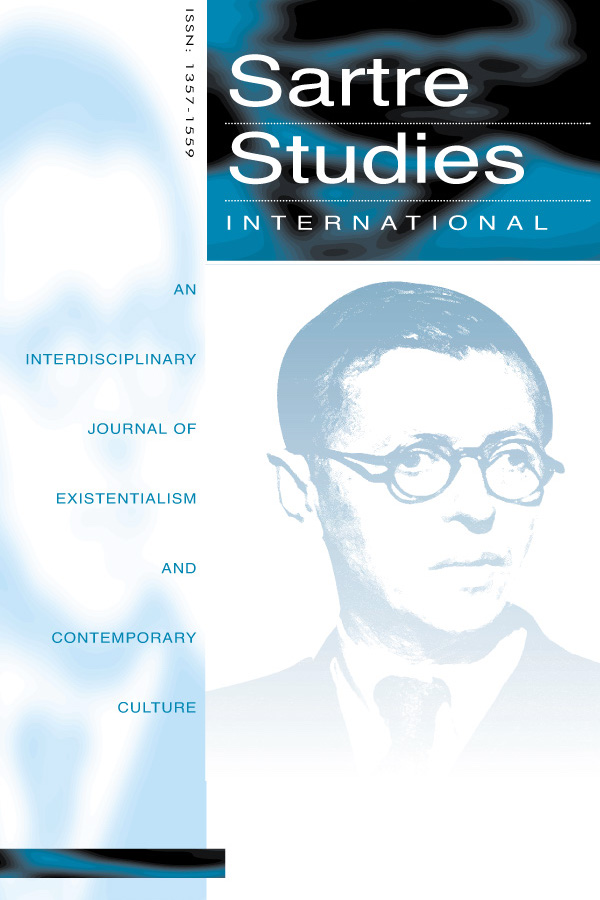
Sartre Studies International
An Interdisciplinary Journal of Existentialism and Contemporary Culture
ISSN: 1357-1559 (print) • ISSN: 1558-5476 (online) • 2 issues per year
Volume 5 Issue 1
Get 35% discount when you checkout 3 or more PDF articles.
Editorial
Several important facets of Sartre’s work are exemplified in this issue of Sartre Studies International: on the one hand, the range and variety of his intellectual and literary achievements (methodological innovation, political intervention, amorous discourse and theatrical exploration); on the other, his interactions with other key intellectuals (specifically, Lefebvre, Camus and de Beauvoir) that were the source of a productive and challenging re-evaluation and reassessment.
Towards a Heuristic Method: Sartre and Lefebvre
Henri Lefebvre rarely looms large in discussions of Sartre, and vice versa. With the notable exception of Mark Poster, critics have generally ignored the role of France’s leading Marxist philosopher in mediating Sartre’s encounter with Marxism. As a result, Sartre’s well-known footnote in the Critique de la raison dialectique, quoted above, may appear as a characteristically quixotic gesture on his part. The purpose of this article is to argue that this relatively isolated acknowledgement is the tip of an iceberg, beneath which there lies a deep and complex philosophical and political relationship. The text was published in 1957 at a moment when Sartre and Lefebvre came to share an unusual degree of common ground. This itself requires detailed examination, but it first needs to be situated in a wider context embracing most of the lifetime of the two thinkers up until that point.
Sartre, Camus and the Algerian War
When considering Sartre’s and Camus’ positions on the Algerian War of Independence, it is useful to begin by briefly locating both men in relation to colonialism in general and Algeria in particular. The first point, an obvious one, but one which needs to be made, is that while Camus, the child of Belcourt, had first-hand knowledge of life in working-class Algiers, and as a journalist of the misery of Kabylia in the late 1930s, Sartre, the Parisian intellectual par excellence, had almost no direct knowledge of the country. I say almost no direct knowledge because he and de Beauvoir did pass through southern Algeria en route to French West Africa in 1950 but apparently paid scant attention to the political situation in that country.
Sartre, May 68 and Literature: Some Reflections on the Problematic of Contestation
To talk about Sartre and literature in the 1960s is to talk about a range of disparate things: at the beginning of the decade stands the farewell to Literature, the myth of literature, enshrined in the autobiographical Les Mots. At the end is the critical dissection of the myth of literature as an absolute in the third volume of L’Idiot de la famille, in a farewell of another kind. As far as Sartre is concerned, then, this was a decade framed by highly public, but also highly ambiguous, statements about literature, ambiguous by their very literariness. Statements which are undoubtedly intensified by the ideological role of literature in the constitution of the figure of the intellectual.
Love from Simone: Epistolarity and the Love Letter
‘My relationship with you and yours with me: idyllic’. Thus wrote Sartre to Beauvoir in a letter of September 1937. Relations between the Sartrean and the Beauvoirian critical fields have not always been quite so harmonious; however, the recent publication of Simone de Beauvoir’s letters to Nelson Algren – three hundred and four letters covering a seventeen-year period (1947-1964) – offers an intriguing intertext to the Beauvoir-Sartre epistolary relation, and an opportunity to work towards a less partisan approach to the work of this most famous of couples.
The Anonymous Hero in Sartre's Theatre
In Les Mots, the fatherless Sartre (‘Jean Sans-père’, to parody the title he had originally envisaged) records that: ‘Rather than the son of a dead man, I was given to understand that I was a miracle child’ (Les Mots, 13). This ‘good fortune of belonging to a dead man’ (14), he recalls a little further on, assured his status as ‘[a] marvel … a conspicuous favour of destiny, … a gratuitous and always revocable gift’ (14-15). The first delightful yet ambiguous consequence of this abstract provenance is an ‘incredible’, and sometimes unbearable, ‘lightness of being’ (13). A later and more menacing consequence is that the ‘imaginary child … from six to nine years old’, living in and through the ‘imagination [of his] intellectual exercises’ (92), discovered when he went to bed at night that he was becoming ‘a solitary adult, without father and mother, without hearth and home, almost without a name’ (94).
Book Reviews
Terry Keefe, Simone de Beauvoir. Macmillan Modern Novelists. Basingstoke: Macmillan Press, 1998, xi + 191pp. ISBN 0-333-63974-X £11.99 (paperback). Review by Ursula Tidd
Jean-François Fourny and Charles D. Minahen, eds, Situating Sartre in Twentieth- Century Thought and Culture, New York: St. Martin’s Press, 1997, 214 pp. ISBN 0-312-16079-8 Review by Andrew Leak
Notice Board
The Notice Board editors will be pleased to publicize events relating to Sartre scholarship, specifically higher degrees, seminars, and conference papers, as well as publications. They will also be pleased to publish conference reports.
Contributors
Notes on contributors