 Get New Issue Alerts
Browse Archive
- Vol 31 Issue 2
- Vol 31 Issue 1
- Vol 30 Issue 2
- Vol 30 Issue 1
- Vol 29 Issue 2
- Vol 29 Issue 1
- Vol 28 Issue 2
- Vol 28 Issue 1
- Vol 27 Issue 2
- Vol 27 Issue 1
- Vol 26 Issue 2
- Vol 26 Issue 1
- Vol 25 Issue 2
- Vol 25 Issue 1
- Vol 24 Issue 2
- Vol 24 Issue 1
- Vol 23 Issue 2
- Vol 23 Issue 1
- Vol 22 Issue 2
- Vol 22 Issue 1
- Vol 21 Issue 2
- Vol 21 Issue 1
- Vol 20 Issue 2
- Vol 20 Issue 1
- Vol 19 Issue 2
- Vol 19 Issue 1
- Vol 18 Issue 2
- Vol 18 Issue 1
- Vol 17 Issue 2
- Vol 17 Issue 1
- Vol 16 Issue 2
- Vol 16 Issue 1
- Vol 15 Issue 2
- Vol 15 Issue 1
- Vol 14 Issue 2
- Vol 14 Issue 1
- Vol 13 Issue 2
- Vol 13 Issue 1
- Vol 12 Issue 2
- Vol 12 Issue 1
- Vol 11 Issue 1
- Vol 10 Issue 2
- Vol 10 Issue 1
- Vol 9 Issue 2
- Vol 9 Issue 1
- Vol 8 Issue 2
- Vol 8 Issue 1
- Vol 7 Issue 2
- Vol 7 Issue 1
- Vol 6 Issue 2
- Vol 6 Issue 1
- Vol 5 Issue 2
- Vol 5 Issue 1
- Vol 4 Issue 2
- Vol 4 Issue 1
- Vol 3 Issue 2
- Vol 3 Issue 1
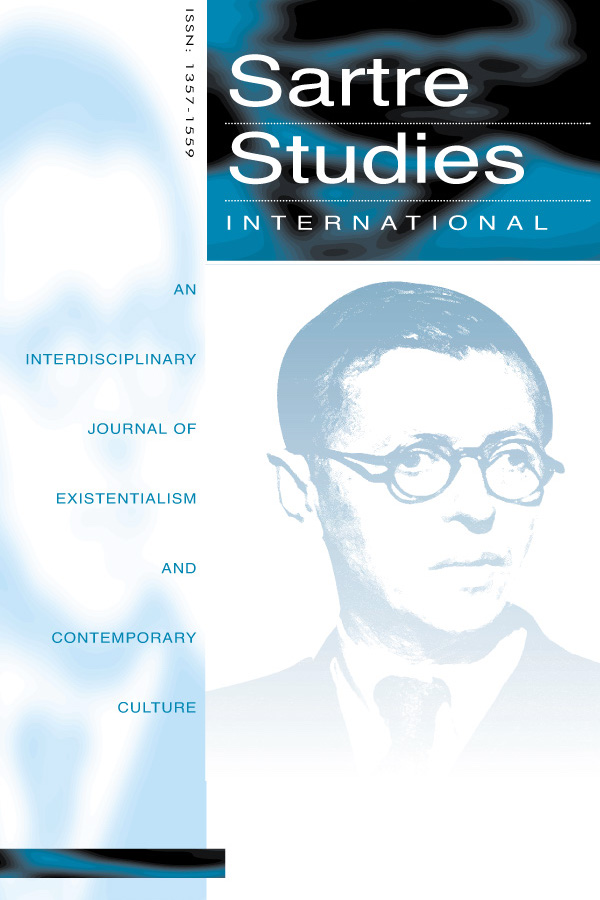
Sartre Studies International
An Interdisciplinary Journal of Existentialism and Contemporary Culture
ISSN: 1357-1559 (print) • ISSN: 1558-5476 (online) • 2 issues per year
Volume 27 Issue 2
Get 35% discount when you checkout 3 or more PDF articles.
Existentialism is an Antiracism
This special issue explores how existential thinking can be a living, global force that opposes racist praxis and thought. We are used to hearing that the “heyday” of existentialism was the middle of the twentieth century. In truth, because existential thought is future-oriented, the heyday of existentialism may be yet to come.
Anti-Racism and Existential Philosophy
An interview with Kathryn Sophia Belle
Kathryn Sophia Belle's (formerly Kathryn T. Gines’) publications engaged in this interview:
2003 (Fanon/Sartre 50 yrs) “Sartre and Fanon Fifty Years Later: To Retain or Reject the Concept of Race,”
2010 (Convergences) “Sartre, Beauvoir, and the Race/Gender Analogy: A Case for Black Feminist Philosophy” in
2011 (Wright/Legacy) “The Man Who Lived Underground: Jean-Paul Sartre and the Philosophical Legacy of Richard Wright,”
2012 (Reflections) “Reflections on the Legacy and Future of Continental Philosophy with Regard to Critical Philosophy of Race,”
Sipping Whiskey in Memphis
A Conversation Between Robert Bernasconi and Jonathan Judaken on Racism and Existentialism
Robert Bernasconi (RB): Jonathan, to get us started, tell me about your background and what brought you to focus on the intersections of existentialism and racism?
Jonathan Judaken (JJ): Well, I grew up in a Jewish family in Johannesburg in Apartheid South Africa. And I think all of those very specific facets of my upbringing are important to the trajectory of my work. My work has been a process of unthinking and dismantling and coming to terms with a past, a family, a legacy that very much defines who I am. I'm attempting to understand myself within the broader frameworks within which I grew up. I left South Africa permanently when I was twelve. This was in the immediate aftermath of the Soweto Riots that were steered by the Black Consciousness movement in South Africa, under the leadership of Steve Biko, a thinker whose framework is so clearly influenced by existentialism.
Interrogating Sartre and Apartheid
In an important article published last year (2020), Tal Sela asserts that Sartre's contributions to the anti-apartheid struggle in South Africa throughout the 1960s are overblown and overestimated. Sartre was motivated, Sela argues, by a desire for self-aggrandizement rather than by any genuine concern for the victims of apartheid racism. This article refutes those claims. In countering Sela's arguments, I revisit in detail Sartre's interventions denouncing the phenomenon of apartheid and establish the importance of Sartre's tireless struggle against racism to highlight the force of his opposition to South Africa's infamous policy and his equally firm commitment to freedom both in his philosophy and personal life.
Sartre
The Civil Code and the Rights of Arabs
This article addresses an area of French colonialism, specifically French Algeria, through the critical lens of Jean-Paul Sartre's theories on race and colonialism developed in
Existential Psychoanalysis and Sociogeny
This article explores Sartre's existential psychoanalysis as a phenomenological method for apprehending the fundamental project of the existent through an examination of the anonymous features of human desire. In grasping the anonymity underlying the “I want,” existential psychoanalysis seeks the meaning of freedom from a standpoint of alterity. I then analyze Fanon's
L'Existentialisme de Sartre est-il un antiracisme ?
This article will examine Sartre's fight against racism in the light of the most basic concepts of existentialism. From its very first articulations, the notion of freedom is connected to existentialism's founding tenet: existence precedes essence. My article demonstrates that just as in his fight against anti-Semitism and the Bad Faith of racist thinking, Sartre holds that every human being is free to determine herself and that race must never be constructed as a determinism constraining that freedom.
Cet article propose de comprendre la lutte contre le racisme dans laquelle Sartre s'est inlassablement engagé à partir des concepts clés de son existentialisme. Dès les premières formulations de la pensée de Sartre, la notion de liberté est à mettre en rapport avec la formule même qui résume l'existentialisme : l'existence précède l'essence. Je démontre dans cet article qu'à l'instar de son combat contre l'antisémitisme et contre la mauvaise foi de la pensée raciste, le combat de Sartre contre le racisme est construit sur l'idée que l'homme est libre de se définir et que sa race même ne saurait être un déterminisme contraignant cette liberté.
Sartre, Bad Faith and Authentic Decolonial Interventions
This article explores the concept of bad faith as conceptualized by Sartre within the context of the existential lived experiences of those Fanon (1965) refers to as the condemned, the racialized, and the dehumanized subjects of the world. I explore the logic of authenticity as a liberatory intervention in relation to decolonial interventions and anti-racist movements such as Black Lives Matter in the USA and across the globe and recently, the #EndSars movement in Nigeria. I will therefore argue that the repudiation of the entrenched universal logic of Euro-American modernity requires one to be authentic in their praxis in order to escape bad faith.
Worth the Meddle
How Community and Literary Engagement Derailed Colonial Exploitation
This article presents a (post)colonial literary analysis of Ousmane Sembène's
The Poverty and Richness of the Imaginary
Sartre on (Anti-)racist Ways of Seeing
There is an ambiguity in Jean-Paul Sartre's
Coalition as a counterpoint to the intersectional critique of The Second Sex
The analogy Simone de Beauvoir draws between “les femmes” and “des Noirs d'Amérique” is a key part of the intersectional critique of
Decolonization as Existential Paradox
Lewis Gordon's Political Commitment to Thinking Otherwise and Setting Afoot a New Humanity
This article offers a critical analysis of Euromodernity through an engagement with the Africana existentialism of Lewis R. Gordon. Drawing on Gordon's recent work