 Get New Issue Alerts
Browse Archive
- Vol 31 Issue 2
- Vol 31 Issue 1
- Vol 30 Issue 2
- Vol 30 Issue 1
- Vol 29 Issue 2
- Vol 29 Issue 1
- Vol 28 Issue 2
- Vol 28 Issue 1
- Vol 27 Issue 2
- Vol 27 Issue 1
- Vol 26 Issue 2
- Vol 26 Issue 1
- Vol 25 Issue 2
- Vol 25 Issue 1
- Vol 24 Issue 2
- Vol 24 Issue 1
- Vol 23 Issue 2
- Vol 23 Issue 1
- Vol 22 Issue 2
- Vol 22 Issue 1
- Vol 21 Issue 2
- Vol 21 Issue 1
- Vol 20 Issue 2
- Vol 20 Issue 1
- Vol 19 Issue 2
- Vol 19 Issue 1
- Vol 18 Issue 2
- Vol 18 Issue 1
- Vol 17 Issue 2
- Vol 17 Issue 1
- Vol 16 Issue 2
- Vol 16 Issue 1
- Vol 15 Issue 2
- Vol 15 Issue 1
- Vol 14 Issue 2
- Vol 14 Issue 1
- Vol 13 Issue 2
- Vol 13 Issue 1
- Vol 12 Issue 2
- Vol 12 Issue 1
- Vol 11 Issue 1
- Vol 10 Issue 2
- Vol 10 Issue 1
- Vol 9 Issue 2
- Vol 9 Issue 1
- Vol 8 Issue 2
- Vol 8 Issue 1
- Vol 7 Issue 2
- Vol 7 Issue 1
- Vol 6 Issue 2
- Vol 6 Issue 1
- Vol 5 Issue 2
- Vol 5 Issue 1
- Vol 4 Issue 2
- Vol 4 Issue 1
- Vol 3 Issue 2
- Vol 3 Issue 1
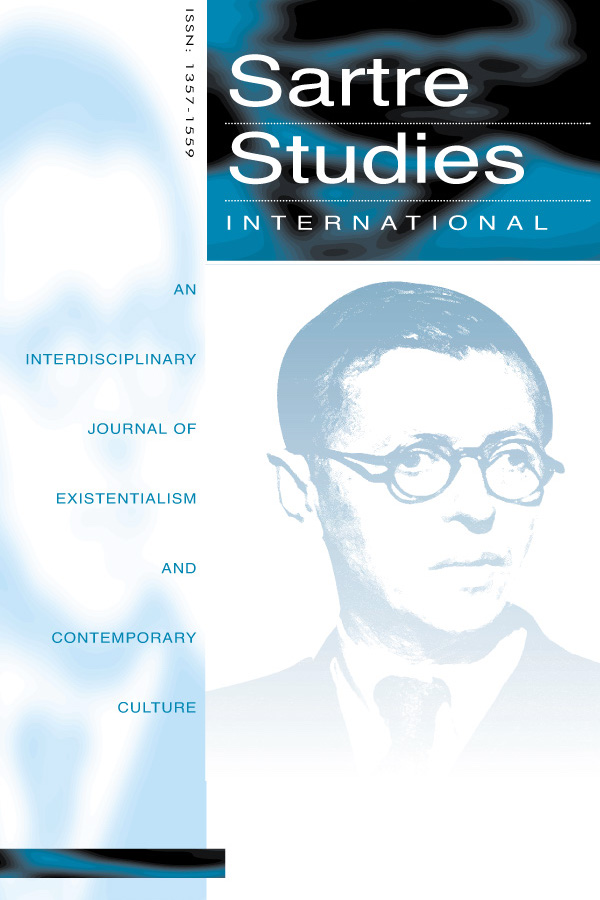
Sartre Studies International
An Interdisciplinary Journal of Existentialism and Contemporary Culture
ISSN: 1357-1559 (print) • ISSN: 1558-5476 (online) • 2 issues per year
Volume 8 Issue 2
Editorial
We open this issue with a translation of a scenario which Sartre wrote during the winter of 1943-44 entitled “Resistance.” It is not unlike several of Sartre’s plays in that it focuses on a weak hero who feels finally compelled to act in a difficult situation. It also displays some striking similarities with the outline provided by Simone de Beauvoir in The Force of Circumstance of “La derniére Chance” [“The Last Chance”]. It is set in occupied France and deals initially with captured soldiers in a POW camp, several of whom are eager to get back to Rouen in order to join the resistance. The conflict between collaborators—those who preached active participation or passive acquiescence in the Nazi power game—and the various forms of resistance— from printing clandestine papers to acts of sabotage—is subtly analyzed in the scenario. The multiple reversals of fortune and the ultimate peripeteia—so typical of Sartre’s plays and stories as well as of the nineteenth century tradition of the “well-made play and story,” do not seem out of place in the WWII setting of occupied France where one’s attitudes and actions could be fatal at any time.
Resistance
Les Temps modernes is publishing here for the first time a film script written by Sartre during the winter of 1943-1944. We thank Daniel Accursi for generously passing it along and Michel Contat for preparing it for publication. Sartre’s article entitled “A film for the postwar period,” which appeared [unsigned] in L’Ecran français and was incorporated into the Lettres françaises [clandestine], no. 15, April 1944, clearly indicates the purpose of this project: “On screen—and only on screen—is there place for a panic-stricken, a furious or a serene crowd. The novelist can evoke the masses; if the dramatist wants to represent them on stage, he must symbolize them by using half a dozen characters who assume the name and function of the chorus; only films show them. And it is to the masses themselves that they do so: to fifteen million or twenty million spectators. It is in this manner that film can speak about the crowd to the crowd. That is what the great pioneers of film, such as Griffith, Cecil B. de Mille and King Vidor understood so well. This does not mean that films cannot show love stories or conflicts between individuals. Far from it. But they must reinsert them into their social setting. The speed with which the camera can move from place to place also permits it to situate a story in the whole universe. The wellknown rule of theatrical unity in French classical drama does not apply at all to film. One can even introduce several plots simultaneously, have them unfold in different settings and have their very diversity contribute to the creation of a complete social situation. The film’s unity therefore emanates from its profound meaning, from the epoch it restores, and not from the concatenation of the circumstances that make up a minuscule and unique anecdote.
The Third Man in the Story: Ronald Aronson Discusses the Sartre-Camus Conflict with Francis Jeanson
For over fifty years Francis Jeanson has been one of the world’s exemplary radical thinkers and actors. We Sartreans know him as the author of one of the earliest, and still most insightful, books on Sartre’s philosophy, Le Problème moral et la philosophie de Jean-Paul Sartre [Available in translation. See Sartre and the Problem of Morality, Bloomington, 1980], Sartre par lui-même, and Sartre dans sa vie, as well as of the review of Camus’ L’Homme révolté [The Rebel, New York, 1954] which instigated the Sartre/Camus break. Then came Algeria. As his biographer writes, “His intervention against the Algerian War shapes our collective destiny. Without Francis Jeanson, the resistance of French intellectuals to this colonial war would have been different” (Marie-Pierre Ulluoa, Francis Jeanson: un intellectuel en dissidence [Paris: Berg International, 2001], 244). At the beginning of the insurrection he and his first wife wrote a book about French colonialism and its effects on Algeria. He then organized the Jeanson network, the “porteurs des valises” who hid Algerian activists and deserters from the French army, and raised money for the FLN. In this role he lived underground for several years and was tried and sentenced in absentia to 10 years prison, a sentence which was only commuted at the end of the war. Jeanson was invited to Chalon-sur-Saône to direct its House of Culture and then worked as a philosopher participating in a continuing education program for psychiatrists in a mental hospital. He then returned to a small family house in Claouey, on the Bassin d’Arcachon, where he has continued to write and involve himself in such activities as the France-Sarajevo Association, which has encouraged a multi-ethnic Bosnia.
Thanks to BHL, France Rediscovers Her Hated Sartre
As if to mark the 20th anniversary of Sartre’s death in 1980—and there was in fact some connection—French writers, journalists, talking heads and publishers put on a Sartre extravaganza. The occasion was the publication of six books on Sartre within the span of a month in early 2000: Denis Bertholet’s Sartre (Plon), Michel-Antoine Burnier’s L’Adieu à Sartre (Plon), Benoit Denis’ Littérature et engagement (Seuil), Bernard-Henri Levy’s Le Siècle de Sartre (Grasset), Philippe Petit’s La Cause de Sartre (P.U.F.), and Olivier Wickers’ Trois Aventures extraordinaires de Jean-Paul Sartre (Gallimard).1 Sartre’s name in headlines was plastered on news kiosks all over Paris during the second half of January, 2000. Le Nouvel Observateur announced: “After 20 Years of Purgatory, Sartre Returns,”2 and Le Point proclaimed: “Sartre: The Passion for Making Mistakes.”3 The implicit warning was: “Don’t let Sartre’s mistakes return!”
Memory and Subjectivity: Sartre in Dialogue with Husserl
When remembering the past, the past appears as my own. After all, I cannot properly speaking recollect any other past than the one that I have lived, even though I can remember events from the historical past and from personal histories recounted to me by others. Authentic recollection occurs necessarily in the first person, i.e. I remember myself in given situations, circumstances and places. Recollection is therefore a cogito experience par excellence, despite the fact that I may have become estranged from my past engagements, emotional attachments or culinary preferences. The difference between myself in the past and myself in the present does not put the underlying identity of one life into question. Memory affirms my personal identity, despite the temporal difference and in that difference, it appears therefore as a privileged context for inquiry into subjective life and possibly even as the ground for upholding the contested notion of “the subject.”1 No wonder then that the way philosophers theorize memory is indicative of their conception of subjectivity as a whole. In what follows, I turn to Sartre and to Husserl with the aim of unveiling how their accounts of recollection resolve the question of identity and difference within the temporality of a subjective life. Tracing Sartre’s arguments against Husserl’s, as well as Husserl’s and Sartre’s own presentations of recollection, I inquire into the reasons that incited them to bring either the aspect of sameness or otherness at the heart of subjective life into view.
Hitting the Slopes with Sartre and Deleuze and Guattari
The general impression that one gets from reading commentaries on Being and Nothingness – which was the same impression that I was left with after my own engagement with the text – is that it seems incredibly difficult for readers to totalize its content. Although the thesis of the text is straightforward enough – that one’s ontological structure, as being-for-itself, “is not to be what I am and to be what I am not” (BN 492), such that all aspects of the existence of the for-itself are reducible to this structure (i.e. the temporal nature of the for-itself, its orientation towards the future, is itself implied within that structure since what the for-self is is yet to come in the future – so the for-itself is what it is not (yet)) – Sartre insists on discussing various aspects of existence that, in the end, do not confirm or conform to his thesis. It is almost as if the ontological proof was an afterthought to his phenomenological insights since his rather simplistic and highly dualistic ontology is frequently at odds in the text with his phenomenological descriptions. For example, in his “Foreword” to Merleau-Ponty’s The Structure of Behavior, Alphonse de Waelhens explains the difficulty that one faces in trying to reconcile Sartre’s insights into corporeity with his ontological conclusions. On the one hand, Sartre’s theses concerning the nature of corporeity – “conceived essentially as a dialectic opposing the body-as-instrument (in a very particular sense) to the body-as-given-in-bare-fact (corps facticiteé) – appear to be exceptionally fruitful and capable of finally allowing us to understand how existing consciousness can be an inherence and a project at the same time” (SB xix). The problem arises when one tries to understand these theses about corporeity in the framework of Sartre’s ontological arguments: “What is unfortunate is that it is difficult to see how these theses can be understood or accepted as soon as one situates oneself, as one must, in the general framework of Sartrean ontology.
Sartre on Authenticity
While the notion of “bad faith” remains stable in Jean-Paul Sartre’s early philosophy, the notions of “pure reflection” and “good faith” undergo significant changes. In Being and Nothingness,2 pure reflection was presented as a necessary but not sufficient condition for authenticity,3 whereas in Notebooks for an Ethics ,4 ‘pure reflection’ and ‘authenticity’ seemed to refer to the same consciousness (although with different emphasis)5 (NE, 12, 472-482, 515). In Being and Nothingness, the project of good faith was introduced as a corrupted mode of being, which, like bad faith, stands in contrast to authenticity (EN, 108-111; BN, 113-116), whereas in Notebooks for an Ethics, Sartre did not seem to distinguish good faith from authenticity (NE, 12).
Book Reviews
Bill Martin, The Radical Project: Sartrean Investigations Elizabeth Butterfield
Kruks, Sonya. Retrieving Experience: Subjectivity and Recognition in Feminist Politics Kathryn T. Gines
Julien S. Murphy, ed., Feminist Interpretations of Jean-Paul Sartre Steve Martinot
Notice Board
Notice Board
Contributors
Notes on contributors