 Get New Issue Alerts
Browse Archive
- Vol 31 Issue 2
- Vol 31 Issue 1
- Vol 30 Issue 2
- Vol 30 Issue 1
- Vol 29 Issue 2
- Vol 29 Issue 1
- Vol 28 Issue 2
- Vol 28 Issue 1
- Vol 27 Issue 2
- Vol 27 Issue 1
- Vol 26 Issue 2
- Vol 26 Issue 1
- Vol 25 Issue 2
- Vol 25 Issue 1
- Vol 24 Issue 2
- Vol 24 Issue 1
- Vol 23 Issue 2
- Vol 23 Issue 1
- Vol 22 Issue 2
- Vol 22 Issue 1
- Vol 21 Issue 2
- Vol 21 Issue 1
- Vol 20 Issue 2
- Vol 20 Issue 1
- Vol 19 Issue 2
- Vol 19 Issue 1
- Vol 18 Issue 2
- Vol 18 Issue 1
- Vol 17 Issue 2
- Vol 17 Issue 1
- Vol 16 Issue 2
- Vol 16 Issue 1
- Vol 15 Issue 2
- Vol 15 Issue 1
- Vol 14 Issue 2
- Vol 14 Issue 1
- Vol 13 Issue 2
- Vol 13 Issue 1
- Vol 12 Issue 2
- Vol 12 Issue 1
- Vol 11 Issue 1
- Vol 10 Issue 2
- Vol 10 Issue 1
- Vol 9 Issue 2
- Vol 9 Issue 1
- Vol 8 Issue 2
- Vol 8 Issue 1
- Vol 7 Issue 2
- Vol 7 Issue 1
- Vol 6 Issue 2
- Vol 6 Issue 1
- Vol 5 Issue 2
- Vol 5 Issue 1
- Vol 4 Issue 2
- Vol 4 Issue 1
- Vol 3 Issue 2
- Vol 3 Issue 1
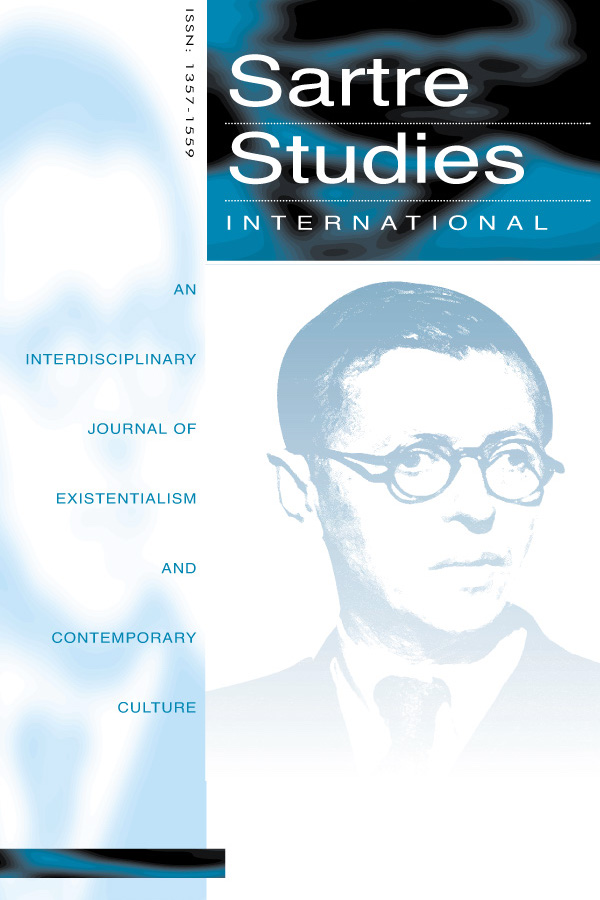
Sartre Studies International
An Interdisciplinary Journal of Existentialism and Contemporary Culture
ISSN: 1357-1559 (print) • ISSN: 1558-5476 (online) • 2 issues per year
Volume 5 Issue 2
Get 35% discount when you checkout 3 or more PDF articles.
Editorial
“Very few people know that Sartre also wrote a fairy tale,” commented Michel Rybalka when he suggested that we translate chapter IV, “Le conte de fées,” from Sartre’s unfinished novel “Une Défaite”, published as part of Ecrits de jeunesse. This story is at once an ironic self-portrait of the young man in his early twenties and, no less important, a first attempt to deal with such concepts as “being-for-others,” “existence” and “consciousness.” Even if the story is part of Sartre’s “juvenalia,” it shows a surprisingly sophisticated grasp of literary technique. Cosima’s role is much more than that of a typical interlocutor, she plays an active role in guiding the narrator along so that the story is transformed into a commentary about psychological interaction and the creative process.
Fairy Tale (from "Une Défaite”)
This is an extract from “Une défaite,” an unfinished novel which, according to Simone de Beauvoir, Sartre wrote in 1927. Apparently, Sartre was inspired by Charles Andler's biography of Nietzsche and the triangular relationship of Nietzsche, Wagner and Cosima Wagner. The latter, Franz Liszt's daughter, was initially married to Hans von Bülow with whom she had two daughters, and then she married Wagner with whom she had two more daughters. Nietzsche admired her greatly. Sartre became fascinated by this ambiguous, complex and conflictual triangle. Sartre also identified with Nietzsche and “the destiny of the solitary man.” The protagonist, Frédéric, who is one year older than Sartre, is also an ironic self-portrait of Sartre, while Cosima is a prototype for Anny in Nausea; both are modelled on Simone Jollivet. Cosima plays both mother and sister to Frédéric. The triangular relationship is often repeated in Sartre's affective existence. The fairy tale is the best written chapter in the novel.
The Curve of the Epoch: Sartre at the end of the Twentieth Century
In this paper I am revisiting an old topic of interest, the relation of Sartre to his century. On an earlier occasion I took up the question of whether his life might count as “oracular” in the sense he lends to that term in The Family Idiot, but at that time the century still had fifteen years to go. Now I can aim for closure: between the submission of this text and its publication the millennial moment – the portentous one, whether or not the “real” one to everybody’s satisfaction – will have passed, with whatever upheaval may have been attendant on it. We can imagine at least that it would have presented no problem to Sartre.
An Encounter Between Sartre and Lacan
An encounter between Sartre and Lacan did in fact take place. What I propose to do in the following text is examine a particular moment of that historical rendezvous, in 1936. The evidence for such a rendezvous cannot be denied for a number of reasons. First of all, the philosopher and the psychoanalyst frequented the same intellectual milieu. Lacan’s interest in philosophy led him to attend Alexandre Kojève’s seminar on Hegel’s Phenomenology of Spirit that ran from 1933 to 1939 at the École pratique des Hautes Études in Paris. In fact, he was listed as “regularly present” at the seminar from 1934 to 1937. Sartre also attended this seminar which “would adjourn to the Café d’Harcourt for further discussions.”
The Site of Postmodernity in Sartre
It is said that Sartre maintained a certain opposition to post-structuralism, for which his focus on a dialectical understanding of historical praxis is considered evidence. Yet he rarely discussed post-structuralism, nor engaged it in debate; which is odd, since it formed part of his philosophical milieu. After all, he took on Marxism and Christianity. But to debate post-structuralism would mean addressing its view of the world, thereby assuming it actually had one. Perhaps he saw that to address it as an ideology, a view of the world, rather than a critique of discursivity itself, would be to transform it into what it was not, against itself.
“Hello, Goodbye”: Derrida and Sartre's Legacy
The fiftieth anniversary issue of Les Temps modernes leads off with an article by Jacques Derrida, “‘Il courait mort’: Salut, salut. Notes pour un courrier aux Temps modernes,” a tribute both to Les Temps modernes and to its founder, Jean-Paul Sartre. For those who have followed what Derrida has said over the years, this “tribute” came as something of a surprise. Derrida, after all, had mocked Sartre as the “onto-phenomenologist of freedom,” always in search of a “fundamental project” that could explain an individual’s whole life; he called “daring” or “risky” Sartre’s criticism of Bataille for having a shaky understanding of German philosophical terms and concepts when Sartre himself had, in Derrida’s view, a very inadequate grasp of Hegel, Husserl and Heidegger.
Sartre's Theory of Emotions: A Reply to His Critics
Early in his career Jean-Paul Sartre dared to speak the truth about human emotions, but his message has hitherto been ignored or summarily rejected. His Sketch for a Theory of the Emotions to date has no defenders because it dispels the panoply of cherished myths surrounding emotion and propounds a thesis that affronts common sense: Emotion is the apotheosis of bad faith. This proposition is as unpalatable as it is revolutionary. Do we really want to accept the fact that joy, love, and compassion are born from duplicitous motives?
Book Review
Sartre and Evil: Guidelines for a Struggle. Haim Gordon and Rivca Gordon. (Westport, CT/London: Greenwod Press, 1995). 235 pp. $59.95
Notice Board
The Notice Board editors will be pleased to publicize events relating to Sartre scholarship, specifically higher degrees, seminars, and conference papers, as well as publications. They will also be pleased to publish conference reports.
Contributors
Notes on contributors