 Get New Issue Alerts
Browse Archive
- Vol 31 Issue 2
- Vol 31 Issue 1
- Vol 30 Issue 2
- Vol 30 Issue 1
- Vol 29 Issue 2
- Vol 29 Issue 1
- Vol 28 Issue 2
- Vol 28 Issue 1
- Vol 27 Issue 2
- Vol 27 Issue 1
- Vol 26 Issue 2
- Vol 26 Issue 1
- Vol 25 Issue 2
- Vol 25 Issue 1
- Vol 24 Issue 2
- Vol 24 Issue 1
- Vol 23 Issue 2
- Vol 23 Issue 1
- Vol 22 Issue 2
- Vol 22 Issue 1
- Vol 21 Issue 2
- Vol 21 Issue 1
- Vol 20 Issue 2
- Vol 20 Issue 1
- Vol 19 Issue 2
- Vol 19 Issue 1
- Vol 18 Issue 2
- Vol 18 Issue 1
- Vol 17 Issue 2
- Vol 17 Issue 1
- Vol 16 Issue 2
- Vol 16 Issue 1
- Vol 15 Issue 2
- Vol 15 Issue 1
- Vol 14 Issue 2
- Vol 14 Issue 1
- Vol 13 Issue 2
- Vol 13 Issue 1
- Vol 12 Issue 2
- Vol 12 Issue 1
- Vol 11 Issue 1
- Vol 10 Issue 2
- Vol 10 Issue 1
- Vol 9 Issue 2
- Vol 9 Issue 1
- Vol 8 Issue 2
- Vol 8 Issue 1
- Vol 7 Issue 2
- Vol 7 Issue 1
- Vol 6 Issue 2
- Vol 6 Issue 1
- Vol 5 Issue 2
- Vol 5 Issue 1
- Vol 4 Issue 2
- Vol 4 Issue 1
- Vol 3 Issue 2
- Vol 3 Issue 1
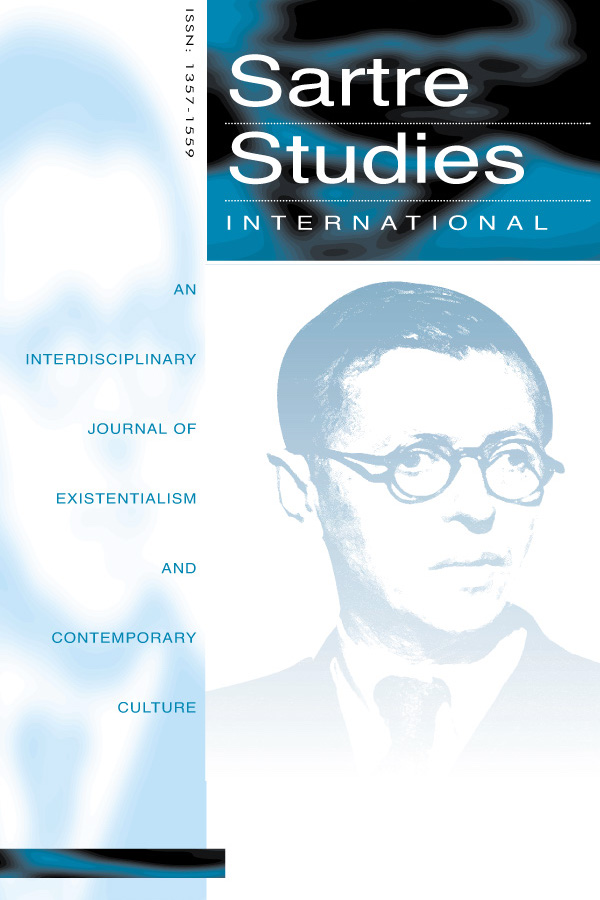
Sartre Studies International
An Interdisciplinary Journal of Existentialism and Contemporary Culture
ISSN: 1357-1559 (print) • ISSN: 1558-5476 (online) • 2 issues per year
Volume 10 Issue 2
Get 35% discount when you checkout 3 or more PDF articles.
Editorial
Some years ago, at a meeting of the Groupe d’études sartriennes in Paris, one of the editors made the claim that to understand Sartre one had to view him as a person who constantly measured himself against the leading lights of the past, of his age, and that at the same time, he foreshadowed the coming age. The contributions in this issue reveal the extent to which recent Sartre scholarship illustrates this point since they emphasize to what enormous degree Sartre remains pivotal to the understanding of ethical questions, postmodernism and such thinkers as Marcuse, Foucault and Fanon, but also such stellar figures from the past as Goethe and Nietzsche.
The End as Present in the Means in Sartre's Morality and History: Birth and Re-inventions of an Existential Moral Standard
The question whether, in the interim, the "socialist morality" allows adequate restraint on revolutionary action, cannot fairly be answered in abstraction from history, in this case our epoch. We submit that the group of projects called corporate "globalization" - imposing free trade, privatization, and dominance of transnational corporations - shapes that epoch. These projects are associated with polarization of wealth, deepening poverty, and an alarming new global U.S. military domination. Using 9/11 as pretext for a "war on terror," this domination backs corporate globalization. If Nazi occupation of France and French occupation of Algeria made Sartre and Beauvoir assign moral primacy to overcoming oppressive systems, then U.S. global occupation should occasion rebirth of that commitment. Parallels among the three occupations are striking. France's turning of colonial and metropolitan working classes against each other is echoed by globalization's pitting of (e.g.) Chinese against Mexican workers in a race to lower wages to get investment. Seducing first-world workers with racial superiority and cheap imports from near-slavery producers once again conceals their thralldom to their own bosses. Nazi and French use of overwhelming force and even torture are re-cycled by the U.S. and its agents, again to hide the vulnerability of their small forces amidst their enemies.
Sartre and Marcuse on the Relation between Needs and Normativity: A Step Beyond Postmodernism in Moral Theory
In this article, I will investigate Sartre's claims regarding need as an element of the human condition, and I will compare them to the analysis of need found in the works of Marx and of Herbert Marcuse. These comparisons will raise important questions, such as: given the cultural diversity of experiences of need, is Sartre justified in speaking of needs common to all humans? Are these human needs to be considered permanent fixtures, or do they change historically? And, how might this affect their status as fundamental and truly human? Finally, is it even possible for us to recognize our real human needs, and to distinguish them from artificially created and alienated false "needs," while we exist in what Sartre identifies as the current state of subhumanity?
Sartre and Foucault: A Cross-Generational Exchange
After an early dalliance with existentialism, Foucault is assumed to have moved away from the thought of Sartre and Merleau-Ponty. As he explained in an interview with Madeline Chapsal: “We had experienced Sartre’s generation as certainly courageous and generous with a passion for life, politics, existence.... But we had discovered some- thing else, another passion: passion for the concept and for what I shall call ‘system.’”1 Of course, the career of that passion for system as well as the structuralist and poststructuralist phases through which it passed is a matter of record. But it is commonly believed that Foucault left Sartrean existentialism far behind during most of his subsequent career.
Sartre and Foucault on Ideal "Constraint"
Although most of the contemporary debates around subjectivity are framed by a rejection of the metaphysical subject, more time needs to be spent developing the implications of abandoning the meta-physics of constraint. Doing so provides the key to approaching our pressing problem that concerns freedom, and only once invisible, ideal "constraints" have been adequately understood will all of the contemporary puzzlement that concerns intentional resistance to power be assuaged. While Sartre does not solve the problem of freedom bequeathed to us by Foucault, it is clear that he struggled with similar issues, and that his work sheds important light on the issue of ideal constraint. Once more, on Sartre's second view, power and freedom are not mutually exclusive, and in this he advances over much contemporary liberal thought. Thus, on the approach of what would be Sartre's hundredth birthday, I invite others to take this opportune moment to reevaluate the early work of this once shining philosophical star, only recently and perhaps prematurely eclipsed by anti-humanism, and recognize that now, more than ever, Sartre's thought is relevant to our very pressing concerns.
How Foucault Can Improve Sartre's Theory of Authentic Political Community
I believe that Sartre's theory of groups, coupled with the suppressed social ontology of BN, does provide an account of how positive and constructive social relations are possible, theoretically and practically. This explicates and makes intelligible the aspect of his concept of authentic existence that requires us to act on behalf of the freedom of all. Sartre's theory of the group does provide a basis for practical union and common effort in our social world, whereby "common" individuals can enrich their concrete freedom.
Sartre, Foucault, and the Subject of Philosophy's Situation
The impetus for exploring the relationship between Sartre and Foucault may be informed more by Foucault than by Sartre, as it would seem to be geared toward a Foucauldian determination of the discursive parameters of a particular dimension of modern philosophy; that is, of the history of philosophy, including, by extension, the history of existentialism. But insofar as this determination opens up a significant dimension of the situation of philosophy today - of our situation and of the situation of existentialism - it is also Sartrean in nature, as are the effects of this determination, a determination situated somewhere between Sartre's philosophy of freedom and the freedom afforded to Foucault and to us all by the practice of philosophy, and by its future possibilities, which include the possibility "… that I do not believe a word, not one little word, of all I've just scribbled."
Identity and Agency in Frantz Fanon
According to those that would label Fanon a theorist of recognition, anti-colonial struggles for liberation are struggles for recognition. I will argue, however, that Fanon's discussion of recognition in Black Skin, White Masks offers a critique of the struggle for recognition, understood as the struggle to impose oneself on the other in order to be recognized as who one truly is. Fanon is critical of the idea that the freedom of colonial subjects will be realized when they are recognized by the colonizer. Indeed, the struggle to be recognized by the colonizer actually perpetuates the oppression of the colonized, insofar as this struggle is a struggle to be recognized within the terms of a discourse that is dictated largely by the colonizer. As Fanon demonstrates, the social categories within which subjects become socially visible beings nevertheless work in the service of subjection. Insofar as this is the case, the struggle to be recognized in socially intelligible terms will yield, at best, ambiguous results. Therefore, I argue that Fanon, unlike contemporary theorists of recognition, is skeptical of the liberatory potential of a struggle for recognition that is directed at securing recognition from the colonial "master." Furthermore, Fanon uses the instance of colonial racial misrecognition as the occasion to criticize the concept of recognition more broadly.
Exceeding Recognition
Hegel’s concept of recognition has been taken up by a number of thinkers, including Axel Honneth, Robert Williams, and Charles Taylor, under the banner of “the politics of recognition,” which pro- poses to put the concept of recognition to use in the service of a theory of politics that can respond to the problems of group-based structural injustice and subordination. According to these thinkers, equal recognition and the possibility of undistorted forms of communicative agreement serve as the regulative ideal that governs the ever-expanding horizon of a community of autonomous, mutually affirming equals, in which, as Honneth writes, each person has “the chance to know that he or she is socially esteemed with regard to his or her abilities.”
Sartre, Fanon, and the Case for Slavery Reparations
In this article I argue that Fanon articulates a more complex relationship between his notion of radical freedom and slavery reparations that allows for the possibility of demanding the latter without sacrificing the former. While at times Fanon seems to posit a simple dilemma according to which one must choose between freedom and reparations, he also describes a vicious cycle in which the taking of material reparations appears to be a precondition for freedom, yet the claim for reparations appears to come at the cost of adoption of a constraining cultural identity. In other words, the process of attaining the material conditions necessary for radical freedom through slavery reparations can have the opposite effect of inhibiting freedom. The question of the possibility of taking reparations without sacrificing freedom becomes a question about the possibility of thinking about enslaved Africans and their descendants as a collective entitled to reparations without positing a constraining cultural identity.
Fanon, Sartre, Violence, and Freedom
Violence is a necessary factor in Frantz Fanon's concept of anti-colonial freedom. What does Fanon mean by violence? Why does he think violence is necessary or good? Is he correct? This article defends the opening statement through an exegesis of primary and secondary literature on Fanon, Jean-Paul Sartre, violence, and freedom. Fanon's The Wretched of the Earth is the central text under analysis. References to Black Skin, White Masks and A Dying Colonialism receive critical scrutiny only in relation to Fanon's overall theory of violence and freedom. I argue that Fanon views violence as intrinsically valuable in the anti-colonial struggle for freedom.
The Invention of Two Women in Les Chemins de la liberté
In this article we will observe Sartre sketching, elaborating, and polishing characters, most of whom he carried around in himself for almost fourteen years. In short, we go back to the beginning of the question of the relationship of the writer and his work, relying above all on the manuscripts we have been able to consult. We postulate, and we will see in the course of this article if it is true, that the choice of writing in a certain way, of inventing a character who takes shape in a particular way, can be conceived as the transformation of a real body into an imaginary one. J. F. Louette expressed it very well in 1996 when he stated that Sartre writes "to change his lymph and blood into ink: to get rid of himself thanks to the sheet of paper, which is not himself; in short … to change the contingency of the body into the necessity of art." Thus, the artist is the man who chooses to create imaginary objects in reality, but also and above all (from the ontological point of view), the man who chooses to create the real world in imagination, whose perception of the situation is in itself creation.
The Devil and the Good Lord: What did Goethe's Faust Contribute to Sartre's Play?
In this article we shall attempt to show that despite the originality of Sartre's writings and the original philosophical views they contain, his reliance on Goethe's Faust in The Devil and the Good Lord proves that he was quite familiar with the components of the former and made intensive use of them in his own play. A comparative analysis of the two texts will show that Sartre exploited any ethical problem, human act, historical name and fact which he was able to fit into his own philosophical and social positions and which could contribute to his dramatic art.
Sartre and Nietzsche
Some have characterized the twentieth century as a Nietzschean century, while others, such as Bernard-Henri Lévy, call this Le siècle de Sartre. Those who are interested in the works of Sartre and Nietzsche wish to know what these two authors, who have left a deep impression on the twentieth century, share in common. Others, myself included, dare to ask: "Was Sartre a Nietzschean?" Studies on this connection are few and, besides Jean-François Louette's book, Sartre contra Nietzsche, no major study exists. What is the particular nature of the relations between their thoughts? Is there an influence of Nietzsche upon Sartre? Is there a philosophical kinship? I will begin by clarifying the question of Sartre's interest in Nietzsche. Then, I will demonstrate that they had the same philosophical starting point: nihilism. Finally, I will show that both give a similar answer to the problem opened by nihilism, the question of meaning.
Book Reviews
Gail Evelyn Linsenbard, An Investigation of Jean-Paul Sartre’s Posthumously Published Notebooks for an Ethics. Lewiston, NY: Edwin Mellen, 2000, 170pp. ISBN 0-7734-7793-4, $99.95.
Notice Board
The Notice Board seeks to publicize all matters relating to Sartre scholarship, but more specifically, higher degrees (in progress or completed), seminars, and conference papers. We are also pleased to publish conference reports and news from Sartre societies. Another important feature of the Notice Board is its record of publications.
Contributors
Notes on contributors