 Get New Issue Alerts
Browse Archive
- Vol 31 Issue 2
- Vol 31 Issue 1
- Vol 30 Issue 2
- Vol 30 Issue 1
- Vol 29 Issue 2
- Vol 29 Issue 1
- Vol 28 Issue 2
- Vol 28 Issue 1
- Vol 27 Issue 2
- Vol 27 Issue 1
- Vol 26 Issue 2
- Vol 26 Issue 1
- Vol 25 Issue 2
- Vol 25 Issue 1
- Vol 24 Issue 2
- Vol 24 Issue 1
- Vol 23 Issue 2
- Vol 23 Issue 1
- Vol 22 Issue 2
- Vol 22 Issue 1
- Vol 21 Issue 2
- Vol 21 Issue 1
- Vol 20 Issue 2
- Vol 20 Issue 1
- Vol 19 Issue 2
- Vol 19 Issue 1
- Vol 18 Issue 2
- Vol 18 Issue 1
- Vol 17 Issue 2
- Vol 17 Issue 1
- Vol 16 Issue 2
- Vol 16 Issue 1
- Vol 15 Issue 2
- Vol 15 Issue 1
- Vol 14 Issue 2
- Vol 14 Issue 1
- Vol 13 Issue 2
- Vol 13 Issue 1
- Vol 12 Issue 2
- Vol 12 Issue 1
- Vol 11 Issue 1
- Vol 10 Issue 2
- Vol 10 Issue 1
- Vol 9 Issue 2
- Vol 9 Issue 1
- Vol 8 Issue 2
- Vol 8 Issue 1
- Vol 7 Issue 2
- Vol 7 Issue 1
- Vol 6 Issue 2
- Vol 6 Issue 1
- Vol 5 Issue 2
- Vol 5 Issue 1
- Vol 4 Issue 2
- Vol 4 Issue 1
- Vol 3 Issue 2
- Vol 3 Issue 1
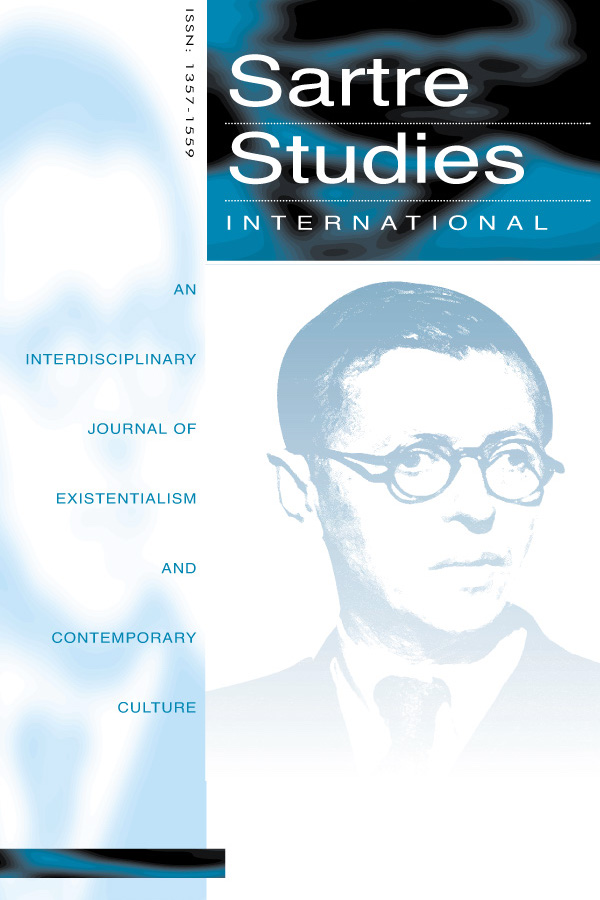
Sartre Studies International
An Interdisciplinary Journal of Existentialism and Contemporary Culture
ISSN: 1357-1559 (print) • ISSN: 1558-5476 (online) • 2 issues per year
Volume 15 Issue 1
Get 35% discount when you checkout 3 or more PDF articles.
Whither Hegelian Dialectics in Sartrean Violence?
Sartrean ontological intersubjectivity is often understood to be hostile and conflictive, and Sartrean dialectics is repeatedly interpreted through the lenses of the Hegelian master-slave dyad, translating into a conflictive theory of practical ensembles. Building on this, critics in the aftermath of 9/11 argued that 'terror' and 'revolutionary violence' introduced in Critique of Dialectical Reason as the anti-thesis of oppression underscored his anti-colonial writings and this gives us justification to think that Sartre might consider terrorism a form of revolutionary violence.
With this in mind, this paper does not deal with the bigger issue of Sartre's political position, but only aims to question the basis of reading Hegelian dialectics in Sartre's ontology of intersubjectivity and social ensembles. Revisiting the role of dialectics in his Search for a Method and Critique of Dialectical Reason, it reveals a Sartre who is critical of Hegelian dialectics, and establishes his intersubjectivity as more compatible with Heidegger's being-with-others rather than Hegel's being-for-others.
Sartre's 'Alternative' Conception of Phenomena in 'Being and Nothingness'
In Being and Nothingness, Sartre explains that being-in-itself is transphenomenal and becomes a phenomenon only through the process by which consciousness qualifies itself as its negation. Thus, there can be no phenomenon except as the object that consciousness (consciously) negates. This ontology of phenomena proves contradictory because one does not understand how consciousness can negate what does not appear to it, especially if it needs to do so as an existentialist freedom, which has to choose (in terms of phenomena) the end towards which it negates being. Sartre's theory of facticity as 'body' then comes as an alternative conception of phenomena, answering these problems by ultimately tending to present being-in-itself as a non-objective, hence non-conscious, phenomenon. Intentional consciousness thus becomes a transcendental condition for objectivity only and not for phenomenality in general.
On the Problem of Origin in Sartre's Phenomenology: Essentialism versus Unlimited Semiosis
One of the basic intuitions guiding Sartre's phenomenological works is that phenomena cannot be reduced to essences that are separate from appearances. Such a separation leads to a type of semiotic profusion that Sartre criticizes in L'Etre et le néant by evoking the example of Proust. Sartre's ontology must avoid this infinite proliferation of meaning without falling into a type of essentialism where things are merely what they appear to be. Sartre's references to Proust demonstrate not only the pitfalls of essentialism and unlimited semiosis, but also why Sartre found it necessary to invent existential psychoanalysis as a response to the twin phenomenological challenge of situating intentional meaning neither on the side of the object, nor of the subject, but somewhere in between. The unsatisfactory nature of Sartre's solution is palpable in the contradictions we discover in his observations on Proust.
The Magical and Bad Faith: Reflection, Desire and the Image of Value
In The Imaginary, Sartre provides the foundation upon which the development of his theory of bad faith is built, pointing to a fundamental choice at the level of image consciousness between the unreflective projection of the image and the impure reflection upon that image constitutive of imaginative comprehension, or what he refers to in this text as pure comprehension. Pure comprehension can be seen as Sartre's early formulation of pure reflection in which thought is characterised by movement rather than the reification of thought indicative of impure reflection and imaginative comprehension. This will prove to have consequences for the interpretation of Sartre's conceptualizations of desire and bad faith and consequently for Sartrean ontology, psychoanalysis and ethics.
Bad Faith and the Actor: Onto-Mimetology from a Sartrean Point of View
The article develops Sartre's remarks on the paradox of the actor in two ways. Firstly, it derives from them an 'existential ontology' of mimetic performance - an 'onto-mimetology'. Secondly, it uses this reconstruction in order to put pressure on Sartre's analogy of the actor with bad faith. In grasping the problem of acting from a Sartrean perspective, I show that this analogy is not as clear cut as he assumes and that a crucial difference exists between the situation of the theatre and that of bad faith. To master the paradox of his own being I argue the actor's technique indeed utilizes the same 'non-persuasiveness-of-belief ' thesis identified by Sartre as the condition of possibility for bad faith, yet in the actor's case it need not necessitate the condition of bad faith. In conclusion, I propose that through the notion of play, the actor sheds intriguing light on Sartre's notion of freedom.
Book Reviews
George J. Marshall, A Guide to Merleau-Ponty’s Phenomenology of Perception Review by Christinia Landry
Comment on the review by Benedict O'Donohoe in SSI, vol. 13, issue 1, 2007 Comment by Ingrid Glaster
Notice Board
The Notice Board seeks to publicise all matters relating to Sartre scholarship, most importantly publications, but also higher degrees (in progress or completed), forthcoming seminars and conferences. We are also pleased to publish conference reports and other Sartre news.
Contributors
Notes on contributors
Abstracts
Abstracts