 Get New Issue Alerts
Browse Archive
- Vol 31 Issue 2
- Vol 31 Issue 1
- Vol 30 Issue 2
- Vol 30 Issue 1
- Vol 29 Issue 2
- Vol 29 Issue 1
- Vol 28 Issue 2
- Vol 28 Issue 1
- Vol 27 Issue 2
- Vol 27 Issue 1
- Vol 26 Issue 2
- Vol 26 Issue 1
- Vol 25 Issue 2
- Vol 25 Issue 1
- Vol 24 Issue 2
- Vol 24 Issue 1
- Vol 23 Issue 2
- Vol 23 Issue 1
- Vol 22 Issue 2
- Vol 22 Issue 1
- Vol 21 Issue 2
- Vol 21 Issue 1
- Vol 20 Issue 2
- Vol 20 Issue 1
- Vol 19 Issue 2
- Vol 19 Issue 1
- Vol 18 Issue 2
- Vol 18 Issue 1
- Vol 17 Issue 2
- Vol 17 Issue 1
- Vol 16 Issue 2
- Vol 16 Issue 1
- Vol 15 Issue 2
- Vol 15 Issue 1
- Vol 14 Issue 2
- Vol 14 Issue 1
- Vol 13 Issue 2
- Vol 13 Issue 1
- Vol 12 Issue 2
- Vol 12 Issue 1
- Vol 11 Issue 1
- Vol 10 Issue 2
- Vol 10 Issue 1
- Vol 9 Issue 2
- Vol 9 Issue 1
- Vol 8 Issue 2
- Vol 8 Issue 1
- Vol 7 Issue 2
- Vol 7 Issue 1
- Vol 6 Issue 2
- Vol 6 Issue 1
- Vol 5 Issue 2
- Vol 5 Issue 1
- Vol 4 Issue 2
- Vol 4 Issue 1
- Vol 3 Issue 2
- Vol 3 Issue 1
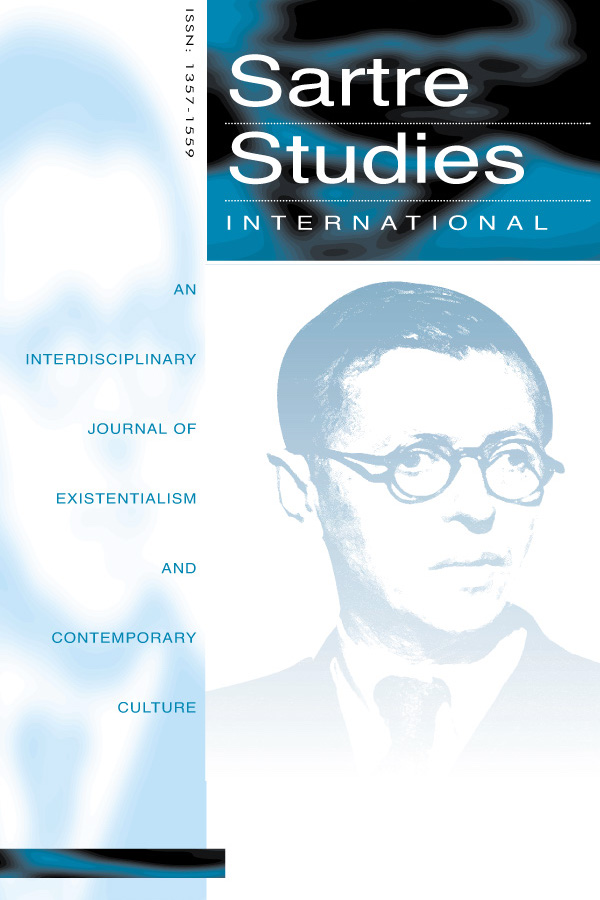
Sartre Studies International
An Interdisciplinary Journal of Existentialism and Contemporary Culture
ISSN: 1357-1559 (print) • ISSN: 1558-5476 (online) • 2 issues per year
Volume 3 Issue 1
Get 35% discount when you checkout 3 or more PDF articles.
Editorial
The first issue of volume three of Sartre Studies International continues the journal’s primary aim of reassessing the relevance and validity of Sartrean ideals and aspirations to a contemporary world. The initial article by Andrew Dobson examines Sartre’s account of Stalin and Stalinism in the second volume of Critique de la raison dialectique, focusing in particular on the balance between historical judgement and historical explanation within a textual dynamics associated with praxis-process. Dobson’s contention that Sartre’s analysis of Stalinism lacks moral judgement is challenged in no uncertain manner by Ronald Aronson who asserts that Dobson has ‘removed Sartre’s ideas from their own complex problematic’, subjecting them without reflection and justification to his own common-sense view of moral behaviour.
Sartre and Stalin: Critique of Dialectical Reason, Volume 2
Sartre’s second volume of the Critique of Dialectical Reason1 presents us with an important irony: of all the phenomena of the twentieth century that demand a moral judgement, Stalinism must be near the top of the list – yet such judgement is hard to find in Sartre’s Critique. Part of my task in the following will be to explain this. It is not that moral judgement is wholly absent: Sartre describes the theory and practice of ‘Socialism in One Country’ as a ‘monstrosity’ [CDR2:103] characterised by ‘its uncouth, misguided crudity’ [CDR2:111], and he has no trouble with peremptorily asserting that the Russian Revolution’s good fortune at being pushed through by the ‘Man of Steel’ was matched on the debit side by Stalin’s ‘universal incompetence’ and his ‘dogmatic crudeness’ [CDR2:205].
Discussion of 'Sartre and Stalin'
Sartre is left out of this commentary on Sartre. As students of Sartre, should we not ground ourselves in what Sartre actually said, in an appreciation of what he was up to, as well as in a willingness to engage the scholarship about his work? Given the richness both of Sartre’s writing and the interpretative literature, an article discussing Sartre’s notion of freedom and criticising his views on morality can fairly be taxed if it lacks these attentions. Of course Andrew Dobson is entitled to argue against Sartre, or against our various interpretations of Sartre, and to show why an anti-Sartrean ethical understanding such as his own is warranted. But what he gives us is misleading, because above all he ignores Sartre’s own evolving conception of freedom, and Sartre’s own changing purposes.
The Intransigence of the Intellectual: Autonomy and Ideology in Althusser and Sartre
Writing in 1966, Roger Garaudy saw Althusser and Sartre occupying the two poles of contemporary French Marxist thought.1 While no-one would deny their fundamental difference in approach, the fact remains that both were participants in the same project – the modernisation of Marxism in the light of theoretical and political problems which had affected its development, with the aim of achieving an autonomous space for the intellectual to engage with Marxist theory and the practice of the working-class struggle. Both were primarily intellectuals; both were capable of intransigence
Sartre and May 1968: The Intellectual in Crisis
Conventional wisdom holds that the political evolution of an individual passes from youthful radicalism to the conservatism of later years. In this respect, as in many others, Sartre declined to follow the norm. As a young man, despite his detestation of the bourgeoisie, his anti-militaristic sentiments, his anti-authoritarianism and unconventional lifestyle, Sartre remained aloof from politics, while it was towards the end of his life that his most radical commitment occurred, triggered in large part by the events of May-June 1968. This paper will establish that although Sartre supported the 1968 student movement, he remained essentially outside it and it made little immediate impact on his thinking or practice; it was only several months later that the ‘events’ made themselves felt to Sartre, leading him to question the definition of himself as intellectual which he had defended hitherto.
Sartre on the Curse of Modern Schools
Modern schools have been criticised by throngs of intellectuals, quite often with justice. Adding the prefix post-modern to some schools has done nothing to temper the validity of much of the criticism. Critics of schools have addressed, among other topics, low learning achievement of pupils and an insipid milieu, a debilitating school social structure and the spread of vile and, at times, criminal behaviour among pupils, a dire lack of genuine spirituality and the spread of a congealing stupidity. Quite a few critics have also discussed a host of rather irrelevant psychological, sociological, and anthropological issues related to schooling. Yet almost all of this criticism has not addressed the ontology of modern schools; nor has it considered the ontic developments that appeared with the burgeoning of schooling.
Toward a Mature Sartrean Ethics: On Catalano's 'Sketch'
Joseph S. Catalano’s most recent book on Sartre, Good Faith and Other Essays,1 is an important work. The fact that Part Two of this book – amounting to just over half of its extent – consists of essays that have appeared previously in journals does not undermine its significance and worthiness. For, viewed together, the essays in this part represent both some needed contemporary refinements of Sartre’s tantalising concept of bad faith and pioneering philosophical explorations of Sartre’s notions of good faith and authenticity. Ready access to them under a single cover increases the chance of their being read, and serves Sartrean scholarship. As background material, they here supplement Part One, Catalano’s brand new, masterfully honed, ‘A Sketch of a Sartrean Ethics’, which is ‘must’ reading for anyone pursuing the implications of an ‘integral’ Sartre for an ‘integral humanity’.
Book Reviews
Jean-Francois Sirinelli, Deux intellectuels dans le siècle, Sartre et Aron, Fayard, 1995, 395 pp. ISBN 2-213-59200-4. 140 FF. Review by David Drake
Jean-Paul Sartre and Benny Levy, Hope Now. The 1980 Interviews, translated by Adrian van den Hoven with an Introduction by Ronald Aronson, Chicago, University of Chicago Press, 1996, 135 pp. ISBN 0-226-47630-8 $19.95 Review by John Ireland
Lewis R. Gordon, Bad Faith and Antiblack Racism, Atlantic Highlands, New Jersey, Humanities Press, 1995, 240 pp. ISBN 0-391- 03872-9 $17.50 Review by Stuart Z. Charme
Notice Board
The Notice Board editors will be pleased to publicize events relating to Sartre scholarship, specifically higher degrees, seminars, and conference papers, as well as publications. They will also be pleased to publish conference reports.
Contributors
Notes on contributors