 Get New Issue Alerts
Browse Archive
- Vol 31 Issue 2
- Vol 31 Issue 1
- Vol 30 Issue 2
- Vol 30 Issue 1
- Vol 29 Issue 2
- Vol 29 Issue 1
- Vol 28 Issue 2
- Vol 28 Issue 1
- Vol 27 Issue 2
- Vol 27 Issue 1
- Vol 26 Issue 2
- Vol 26 Issue 1
- Vol 25 Issue 2
- Vol 25 Issue 1
- Vol 24 Issue 2
- Vol 24 Issue 1
- Vol 23 Issue 2
- Vol 23 Issue 1
- Vol 22 Issue 2
- Vol 22 Issue 1
- Vol 21 Issue 2
- Vol 21 Issue 1
- Vol 20 Issue 2
- Vol 20 Issue 1
- Vol 19 Issue 2
- Vol 19 Issue 1
- Vol 18 Issue 2
- Vol 18 Issue 1
- Vol 17 Issue 2
- Vol 17 Issue 1
- Vol 16 Issue 2
- Vol 16 Issue 1
- Vol 15 Issue 2
- Vol 15 Issue 1
- Vol 14 Issue 2
- Vol 14 Issue 1
- Vol 13 Issue 2
- Vol 13 Issue 1
- Vol 12 Issue 2
- Vol 12 Issue 1
- Vol 11 Issue 1
- Vol 10 Issue 2
- Vol 10 Issue 1
- Vol 9 Issue 2
- Vol 9 Issue 1
- Vol 8 Issue 2
- Vol 8 Issue 1
- Vol 7 Issue 2
- Vol 7 Issue 1
- Vol 6 Issue 2
- Vol 6 Issue 1
- Vol 5 Issue 2
- Vol 5 Issue 1
- Vol 4 Issue 2
- Vol 4 Issue 1
- Vol 3 Issue 2
- Vol 3 Issue 1
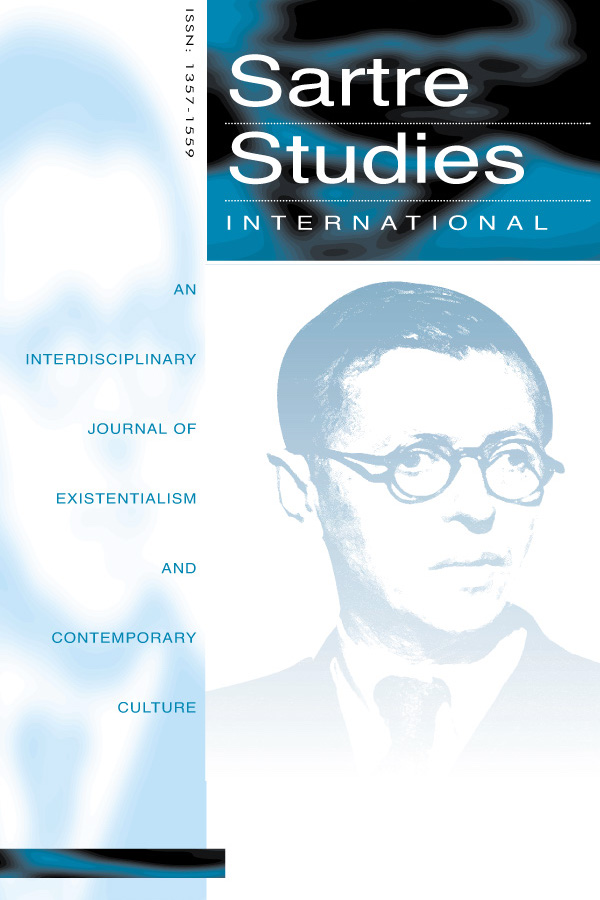
Sartre Studies International
An Interdisciplinary Journal of Existentialism and Contemporary Culture
ISSN: 1357-1559 (print) • ISSN: 1558-5476 (online) • 2 issues per year
Volume 7 Issue 1
Get 35% discount when you checkout 3 or more PDF articles.
Editorial
The reawakening of interest in Sartre outside of specialist circles prompted by the publication of Lévy’s Le siècle de Sartre shows no sign of abating as we move into the new century. In England, it is true, a combination of endemic anti-intellectualism and age-old francophobia has conspired to ensure that Sartre’s face has sadly not graced the covers of Hello! Magazine or Home and Garden, but the theatre has proved more welcoming. Following Richard Eyre’s revival of Dirty Hands in Spring 2000, there have been two new productions of No Exit. The later of the two (Spring 2001) was unfortunately too recent for Ben O’Donohoe to be able to include in his witty review, in this issue, of the reception of Sartre’s theatre in the USA and UK; however, if the publicity bumph is anything to go by (‘Hilarious!’, ‘Uproariously funny!’) the director would appear to have tapped into a rich comic vein that had remained concealed these fifty-five years past.
Dramatically Different: The Reception of Sartre's Theatre in London and New York
The autumn of 1998 saw a fiftieth anniversary revival of Sartre’s Les Mains sales at the Théâtre Antoine in Paris, complete with facsimile programme of its premiere, placing emphasis upon the chequered history of this controversial play. The review in Le Monde also privileged an account of the political context of the play’s creation over an assessment of the production’s virtues: ‘Nous regardons la photo un peu passée de ce qui nous avait secoués.’ This reception suggests that Sartre the dramatist is already remembered chiefly as the author of circumstantial and thesis plays whose interest depended largely upon their historical moment. It is noticeable that other pastmasters, more ‘past’ than Sartre – Molière, Racine, Feydeau – attracted greater critical attention in the Parisian rentrée of that year, as did one near-anagrammatic contemporary, Nathalie Sarraute.
On Pure Reflection in Sartre's
‘Pure reflection’ is an important concept that bridges Sartre’s ontology and ethics in his early philosophy. In Being and Nothingness, Sartre devoted a section (Part Two, Chapter Two, Section III) to a discussion of the ontological characteristics of pure reflection. In Notebooks for an Ethics,3 he explored the ethical implications of the ontological characteristics of pure reflection (that he had presented in Being and Nothingness) and he used pure reflection as an essential stage leading to an ethical life of ‘authenticity’.
The Poetics of Morality: The Notion of Value in the Early Sartre
‘C’est dans la connaissance des conditions authentiques de notre vie qu’il nous faut puiser la force de vivre et des raisons d’agir’ states Simone de Beauvoir at the outset of her plea for an existentialist ethics in Pour une morale de l’ambiguïté. Surely, very few philosophers would disagree with her. A correct understanding of the ‘human condition’ has always been held indispensable to the formulation of any moral philosophy, and it seems all the more necessary in the context of an existentialist theory which, in denying the existence of a common human nature, places all the emphasis on the self-made aspect of human life.
A Response to Hannah Arendt's Critique of Sartre's Views on Violence
In her essay On Violence (1970), Hannah Arendt criticizes what she calls Sartre’s ‘new faith’ of violence. She argues that his call to the oppressed peoples to turn to a violent struggle to achieve freedom from colonialisation is an idea that was not known in the history of revolutions. In addition, Sartre’s glorification of violence is totally opposed to the Hegelian and Marxian tradition, and to any ‘leftist humanism’. Therefore, Sartre should be included, she holds, among ‘the new militants’ or ‘the new preachers of violence’ of the New Left. To support her views, Arendt criticizes passages in Sartre’s Critique of Dialectical Reason and in his preface to Frantz Fanon’s The Wretched of the Earth.
Book Reviews
Bernard-Henri Lévy, Le Siècle de Sartre, Paris: Grasset, 2000, 663 pp. 148 FF. ISBN 2- 246-59221-6 Review by Keith Reader
Lendemains: ‘Cinquante ans après Le Deuxième Sexe: Beauvoir en débats’ 24. Jahrgang, 1999, 94. ISBN 3-86057-964-9 Review by Reidar Due
James Giles, ed., French Existentialism; Consciousness, Ethics and Relations with Others, Amsterdam/Atlanta: Rodopi, 1999, 219 pp. £19.50 Review by Natascha H. Lancaster
Notice Board
The Notice Board will be pleased to publicise events relating to Sartre scholarship, specifically higher degrees, seminars and conference papers, as well as publications. We will also be pleased to publish conference reports.
Contributors
Notes on contributors