 Get New Issue Alerts
Browse Archive
- Vol 31 Issue 2
- Vol 31 Issue 1
- Vol 30 Issue 2
- Vol 30 Issue 1
- Vol 29 Issue 2
- Vol 29 Issue 1
- Vol 28 Issue 2
- Vol 28 Issue 1
- Vol 27 Issue 2
- Vol 27 Issue 1
- Vol 26 Issue 2
- Vol 26 Issue 1
- Vol 25 Issue 2
- Vol 25 Issue 1
- Vol 24 Issue 2
- Vol 24 Issue 1
- Vol 23 Issue 2
- Vol 23 Issue 1
- Vol 22 Issue 2
- Vol 22 Issue 1
- Vol 21 Issue 2
- Vol 21 Issue 1
- Vol 20 Issue 2
- Vol 20 Issue 1
- Vol 19 Issue 2
- Vol 19 Issue 1
- Vol 18 Issue 2
- Vol 18 Issue 1
- Vol 17 Issue 2
- Vol 17 Issue 1
- Vol 16 Issue 2
- Vol 16 Issue 1
- Vol 15 Issue 2
- Vol 15 Issue 1
- Vol 14 Issue 2
- Vol 14 Issue 1
- Vol 13 Issue 2
- Vol 13 Issue 1
- Vol 12 Issue 2
- Vol 12 Issue 1
- Vol 11 Issue 1
- Vol 10 Issue 2
- Vol 10 Issue 1
- Vol 9 Issue 2
- Vol 9 Issue 1
- Vol 8 Issue 2
- Vol 8 Issue 1
- Vol 7 Issue 2
- Vol 7 Issue 1
- Vol 6 Issue 2
- Vol 6 Issue 1
- Vol 5 Issue 2
- Vol 5 Issue 1
- Vol 4 Issue 2
- Vol 4 Issue 1
- Vol 3 Issue 2
- Vol 3 Issue 1
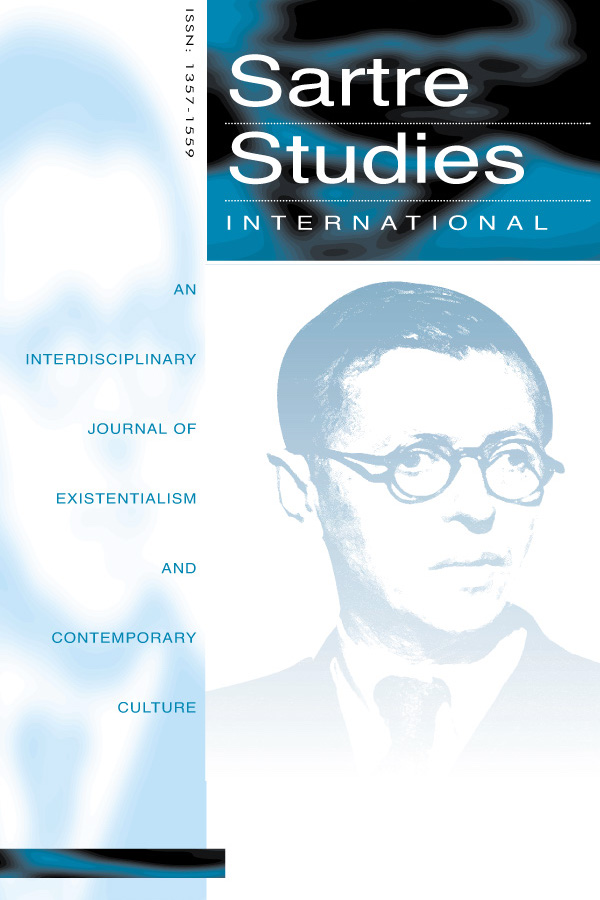
Sartre Studies International
An Interdisciplinary Journal of Existentialism and Contemporary Culture
ISSN: 1357-1559 (print) • ISSN: 1558-5476 (online) • 2 issues per year
Volume 13 Issue 1
Get 35% discount when you checkout 3 or more PDF articles.
Editorial
On the shelves labelled ‘Just published and shortly to be remaindered’, customers of ‘all the best bookstores’ will perhaps notice a volume by Mr Clive James entitled Cultural Memories: Necessary Memories from History and the Arts. Indeed, it would be hard not to notice this 876 page monument to its author’s verbosity. US readers will perhaps not recognise the name of this television critic turned Conscience of the Twentieth Century, but UK readers will be long familiar with his inimitable brand of soft right-wing bombast masquerading as common sense and delivered with ponderous wit.
Was Existentialism Truly a Humanism?
A few years ago, while reading Sartre’s ‘reflections on the Jewish question’ in the course of a seminar on Being and Nothingness,1 I was literally dumbfounded by the uncanny similarity between some of Sartre’s expressions and what I had written myself under the influence of authors like Lyotard or Lacan, whom I took to be his antipodes. The more I read, the less difference I saw and the more I underwent a kind of depersonalisation.
A Différance of Nothing: Sartre, Derrida and the Problem of Negative Theology
As Christina Howells notes in ‘Sartre and Negative Theology’, it is easily assumed that Sartre was ‘a God-haunted or Spirit-haunted atheist, one haunted if not by the god of Christianity then at least by the god of idealism’.1 Sartre himself, as the above epigraph suggests, was all too aware of the spectre of idealism that haunted—or better, tainted—his early philosophical endeavours.
Spinozean Multitude: Radical Italian Thought vis-à-vis Sartrean Existential Marxism
The present paper aims to explore the Spinozean notion ‘multitude’ as it is used in texts by Antonio Negri and Paolo Virno, although I shall only touch upon the latter’s work to the extent that it appears to agree with Negri’s theses. Doing so will bring up an issue which, in my view, impinges on the articulation of the praxis of liberation envisioned by the above philosophers. In particular, although their analyses adopt ontology as a point of departure, and this is a core methodological tenet in their thought, they fall short of offering an account of the ontological structures of agency which would be adequate to ground the motivation for the appointed ethico-political task.
Images of Cuba in France in the 1960s: Sartre's 'Ouragan sur le sucre'
It is no exaggeration to state that before the Revolution of 1958–1959 Cuba barely impinged on the French national consciousness, with the exception of the occasional role of Paris as host for international conferences on the island’s future. The island’s French colony was never large: indeed, the mausoleum in the Necropólis Cristóbal Cólon in Havana is a touching reminder of a small group, numbering no more than sixty, who, between the 1930s and the early 1960s, maintained a fragile French commercial presence.
Book Review
Ingrid Galster (ed.), Sartre devant la presse d’Occupation: Le dossier cri- tique des ‘Mouches’ et ‘Huis clos’. Textes réunis et présentés par Ingrid Galster. Rennes, Presses Universitaires de Rennes, collection ‘Interférences’, 2005, 474pp. ISBN 2-7535-0103-3. €23 (paper- back).
Notice Board
The Notice Board seeks to publicise all matters relating to Sartre scholarship, including publications, higher degrees (in progress or completed), seminars and conference papers. We are also pleased to publish conference reports and news from Sartre societies.