Home eBooks Open Access Journals
Home
Subscribe: Members Articles RSS Feed Get New Issue Alerts
Browse Archive

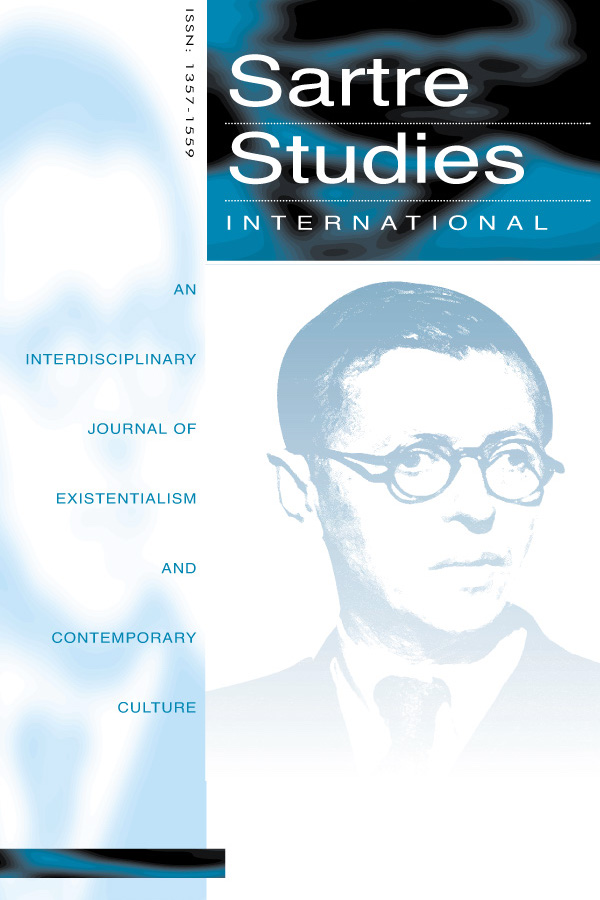
Sartre Studies International

An Interdisciplinary Journal of Existentialism and Contemporary Culture

ISSN: 1357-1559 (print) • ISSN: 1558-5476 (online) • 2 issues per year

Volume 29 Issue 2

Editorial

In this issue, two authors offer a phenomenological analysis of contemporary social phenomenon (political torture and jazz). The other two authors engage Sartrean literature. The theme of being situated runs through all four pieces. Sartre not only collected many of his shorter essays under the title of Situations, he developed an entire philosophy based on the premise that humans are free only within-a-situation. Unlike any other author before or since, Sartre found a way to express his vision of human freedom in philosophical texts, plays, novels, and journalism. The four authors in this volume draw on Sartre's unparalleled ability to combine artistic and philosophical expression.

Tortured Freedom

A Sartrean Critique of Political Tortured Confessions in Iran

Hamid Andishan Abstract

Political prisoners in the Islamic Republic of Iran are tortured to the point that they may be psychologically broken, confess to something against their will, and actively bring degrading effects upon themselves. Phenomenologists maintain that consciousness is thoroughly intertwined with the body. It is not that we have bodies but that we are our bodies. In light of this position, torturing the body thus allows the torturer to break the consciousness and freedom of the tortured. How can tortured individuals stand up again as authentic and free agents after their forced confessions? I will examine the relationship between tortured confessions and human freedom, basing my examination on the experiences of Iranian political activists. I argue that, although the victim's consciousness has been manipulated, the victim's freedom is as intact as it was before the tortured confession.

Jazz Improvisation and Creolizing Phenomenology

Craig Matarrese Abstract

Jazz improvisation requires a set of phenomenological practices, through which musicians confront their own sonic situatedness. Drawing on writings from Paget Henry, Mike Monahan, and Storm Heter, these phenomenological practices can be characterized as creolizing, and can reveal a sense in which, as Sidney Bechet says, music gives you its own understanding of itself. Specifically, improvising musicians engage their own situatedness by slowing things down, and through repetition. Bass players can listen through other players’ hands, and audiences can hear more of what's happing in jazz by understanding the ways musicians practice.

Towards a Phenomenology of Reflective Identification

Mirror Theme

Simone Villani Abstract

This article deepens themes from Sartre's Being and Nothingness by studying the relevance of the mirror in his play Huis Clos. The mirror can be understood as a means for escaping anguish by identification with the reflected image-object, but also as a figure of the sado-masochistic relationship between two of the play's characters. What is at stake is our possibility of conceiving ourselves as objects independently of the Other. In truth, it is the Other's look that first reveals our objectivity, and is our being-for-Others that allows us to have objectivity at all. This is not to be overlooked in our attempt to avoid bad faith.

Philosophical Fiction as World Literature

Jean-Paul Sartre's

Aaron Castroverde Abstract

This article will examine Jean Paul Sartre's Nausea from the perspectives of philosophical fiction and world literature. Philosophical fiction is a specific kind of literature that insists on its absolute modernity. However, the literary aspects of philosophical fiction place it within its political and historical context, thus threatening this pretense to universality. Our examination of Nausea will show the internal tension between philosophy and fiction and how the interplay of both of those elements informed the structure of the novel. The formal, literary aspects help further the actual philosophical content that purports to be the central focus. The implications of that interplay will lead us to a new understanding of the inner logic of world literature.

Book Reviews

Matthew C. EshlemanPhillip BarronNahum BrownJ. Reese FaustBrooks Kirchgassner

Bruce Baugh, Philosophers’ Walks (New York: Routledge, 2022), 251 pp., $48.95 (paperback), ISBN: 978-0-3673-3313-3

Marco Cavallaro and George Heffernan (editors), The Existential Husserl: A Collection of Critical Essays (New York: Springer, 2022), 354 pp., $119.99 (hardback), ISBN 978-3-031-05094-7

Mary L. Edwards, Sartre's Existential Psychoanalysis: Knowing Others (London: Bloomsbury, 2023), 258 pp., $115.00 (hardback), ISBN 978-1-350-17347-7, $39.95 (paperback), ISBN 978-1-350-33107-5.

Elisa Magrì and Paddy McQueen, Critical Phenomenology: An Introduction (Cambridge and Hoboken: Polity, 2023), 240 pp., $24.95 (paperback), ISBN: 978-1-5095-4112-6

Michael J. Monahan, Creolizing Practices of Freedom: Recognition and Dissonance (Lanham: Roman & Littlefield, 2023), 206 pp., $105 (hardback), ISBN 978-1-5381-7461