 Get New Issue Alerts
Browse Archive
- Vol 31 Issue 2
- Vol 31 Issue 1
- Vol 30 Issue 2
- Vol 30 Issue 1
- Vol 29 Issue 2
- Vol 29 Issue 1
- Vol 28 Issue 2
- Vol 28 Issue 1
- Vol 27 Issue 2
- Vol 27 Issue 1
- Vol 26 Issue 2
- Vol 26 Issue 1
- Vol 25 Issue 2
- Vol 25 Issue 1
- Vol 24 Issue 2
- Vol 24 Issue 1
- Vol 23 Issue 2
- Vol 23 Issue 1
- Vol 22 Issue 2
- Vol 22 Issue 1
- Vol 21 Issue 2
- Vol 21 Issue 1
- Vol 20 Issue 2
- Vol 20 Issue 1
- Vol 19 Issue 2
- Vol 19 Issue 1
- Vol 18 Issue 2
- Vol 18 Issue 1
- Vol 17 Issue 2
- Vol 17 Issue 1
- Vol 16 Issue 2
- Vol 16 Issue 1
- Vol 15 Issue 2
- Vol 15 Issue 1
- Vol 14 Issue 2
- Vol 14 Issue 1
- Vol 13 Issue 2
- Vol 13 Issue 1
- Vol 12 Issue 2
- Vol 12 Issue 1
- Vol 11 Issue 1
- Vol 10 Issue 2
- Vol 10 Issue 1
- Vol 9 Issue 2
- Vol 9 Issue 1
- Vol 8 Issue 2
- Vol 8 Issue 1
- Vol 7 Issue 2
- Vol 7 Issue 1
- Vol 6 Issue 2
- Vol 6 Issue 1
- Vol 5 Issue 2
- Vol 5 Issue 1
- Vol 4 Issue 2
- Vol 4 Issue 1
- Vol 3 Issue 2
- Vol 3 Issue 1
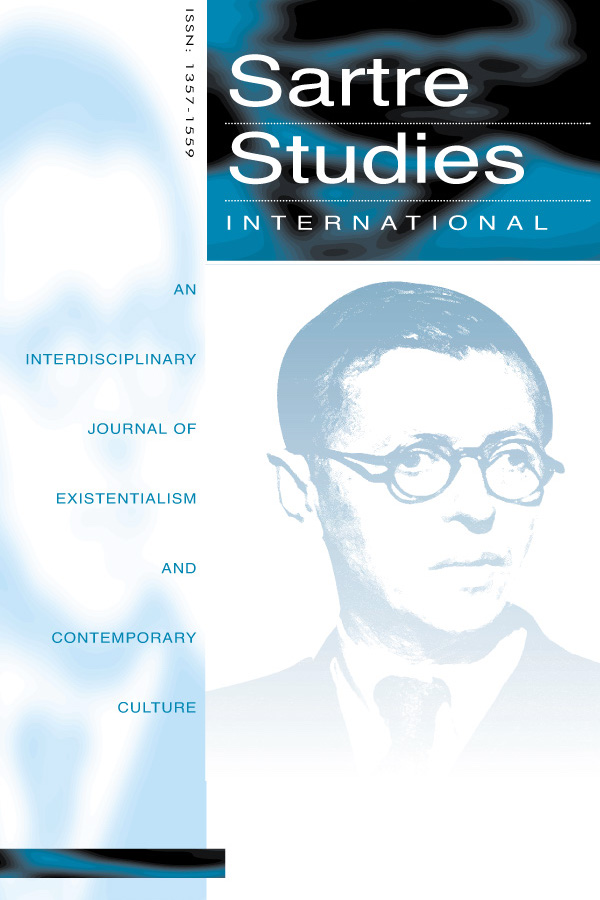
Sartre Studies International
An Interdisciplinary Journal of Existentialism and Contemporary Culture
ISSN: 1357-1559 (print) • ISSN: 1558-5476 (online) • 2 issues per year
Volume 23 Issue 2
Get 35% discount when you checkout 3 or more PDF articles.
Editorial
Sartre in Austria
Boycott, Scandals, and the Fight for Peace
While the World Congress of People for Peace 1952 in Vienna is generally viewed as Soviet propaganda, Jean-Paul Sartre counted it among the most important experiences of his life. His participation marks a major turning point in his evolution, insofar as it publicly confirms his status as a fellow traveler of the Communist Party. In the weeks leading up to the Congress, which was met by an extensive press boycott, Sartre had already caused a stir in the Viennese media by calling off the premiere of
“One Is Not Born a Dramatist”
The Genesis of Sartre’s Theatrical Career in Writings to, with, and by Beauvoir
This article looks to delineate Jean-Paul Sartre’s entry into the field of drama and the genesis of his prominent theatrical career. While Sartre spoke and wrote a great deal on this subject in interviews with theater critics and articles on theater, the most revealing sources of this information can be found in writings to, with, and by Simone de Beauvoir. This article therefore examines the exchange of letters between Sartre and Beauvoir, her wartime diary, an article and a recording by her from the 1940s, her autobiography, and the lengthy conversations between the two from 1974. The result will shed significant light on the evolution of Sartre’s interest in theater from his childhood, to his adolescence, and during the decade that preceded the creation of his first extant play,
Sartre et la figure de Cassandre
Cet article examine les références discrètes mais persistantes et variées à Cassandre, princesse troyenne et prophétesse malheureuse, chez Sartre, depuis les œuvres de jeunesse jusqu’aux textes tardifs et sa dernière pièce,
Disharmonious Continuity
Critiquing Presence with Sartre and Derrida
The traditional interpretation of the Sartre-Derrida relationship follows their own insistence that they are separated by a certain irreducible distance. Contemporary research has, however, questioned that assessment, mainly by reassessing the thought of Sartre to picture him as a precursor to poststructuralism/deconstruction. This article takes off from this stance to suggest that Sartre and Derrida are partners against a common enemy—ontological presence—but develop different paths to overcome it: Sartre affirming nothingness and Derrida affirming
The Authentic Person’s Limited Bad Faith
Drawing on Sartre’s account of violence, I argue that not only is bad faith inevitable in practice, but a limited bad faith is necessary for authenticity. Although violating the freedom of others is bad faith, it is impossible to never violate anyone’s freedom. Moreover, and more fundamentally, the ontological structure of the for-itself entails that the for-itself can only be authentic in the mode of not being authentic. Seeking to altogether avoid bad faith is bad faith, for it is an attempt to constitute oneself as essentially authentic, yet the for-itself has no preexisting essence. By recognizing one’s complete responsibility for choosing bad faith, however, one limits one’s bad faith. This limited bad faith is in fact necessary to authenticity, which is a project lived out in concrete situations and not a categorical moral law that forbids bad faith.
Sartrean Self-Consciousness and the Principle of Identity
Sartre’s Implicit Argument for the Non-Self-Identity of the Subject
I address the problem of what grounds Sartre’s paradoxical claim that consciousness is non-self-identical, and his equally paradoxical gloss on that claim—that the nature of consciousness is to be what it is not and not to be what it is. I argue that there is an implicit argument in