 Get New Issue Alerts
Browse Archive
 PDF issue available for purchase
 Print issue available for purchase
- Vol 11 Issue 1
- Vol 10 Issue 2
- Vol 10 Issue 1
- Vol 9 Issue 2
- Vol 9 Issue 1
- Vol 8 Issue 2
- Vol 8 Issue 1
- Vol 7 Issue 2
- Vol 7 Issue 1
- Vol 6 Issue 2
- Vol 6 Issue 1
- Vol 5 Issue 2
- Vol 5 Issue 1
- Vol 4 Issue 2
- Vol 4 Issue 1
- Vol 3 Issue 2
- Vol 3 Issue 1
- Vol 2 Issue 2
- Vol 2 Issue 1
- Vol 1 Issue 2
- Vol 1 Issue 1
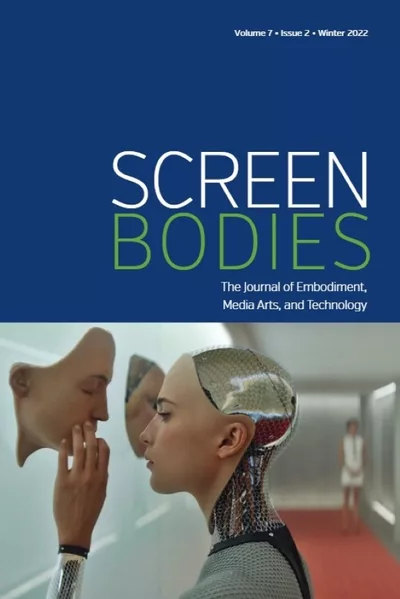
Screen Bodies
The Journal of Embodiment, Media Arts, and Technology
ISSN: 2374-7552 (print) • ISSN: 2374-7560 (online) • 2 issues per year
Published Open Access as part of the Berghahn Open Society collection.
Reina Gossett, Eric A. Stanley, and Johanna Burton, eds., Trap Door: Trans
Cultural
Production and the Politics of Visibility (Cambridge, MA: MIT Press,
2017), 419 pp. ISBN: 9780262036603 (hardback, $49.95) Katharina Lindner, Film Bodies: Queer Feminist Encounters with Gender and
Sexuality in Cinema (London: I. B. Tauris, 2018), 272 pp. ISBN: 9781784536244
(hardback, £72) Saige Walton, Cinema’s Baroque Flesh: Film, Phenomenology, and the Art of
Entanglement (Amsterdam: Amsterdam University Press, 2016), 280 pp. ISBN
978 90 8964 951 5 (hardback, €95) Marietta Kesting, Affective Images: Post-apartheid Documentary Perspectives
(Albany: State University of New York Press, 2017). vi +278pp. ISBN:
9781438467856 (hardback, $95); ISBN: 9781438467849 (paperback, $29.95) This issue of Screen Bodies features a Screen Shots section focusing on screening
disability, including essays on new disability documentaries, vacillation and the
dis/abled male body—especially as it plays out in Fred Zimmerman’s 1950 film
The Men—and questions of masquerade and representations of Richard III on
stage and screen. It also includes general essays on “undoing” gender through
complicity and subversion, the rise in the importance of the haptic in Japanese
society, culture, and filmmaking in the 1920s, and an investigation of uncertainty
and the “generosity paradox” with regard to gender, sexuality, and
ability in cyborg cinema. Michael Haneke’s The Piano Teacher (2001) and Darren Aronofsky’s
Black Swan (2010) are films about women directed by men. Both films unorthodoxly
chart women artists’ struggle with the discipline imposed on them by
the arts and by their live-in mothers. By portraying mothers as their daughters’
oppressors, both films disturb the naïve “women = victims and men = perpetrators”
binary. Simultaneously, they deploy audiovisual violence to exhibit the
violence of society’s gender and sexuality policy norms and use gender-coded
romance narratives to subvert the same gender codes from within this gender
discourse. Using Judith Butler’s and Michael Foucault’s theories, we argue
that Haneke and Aronofsky “do” feminism unconventionally by exposing the
nexus of women’s complicity with omnipresent societal power structures that
safeguard gender norms. These films showcase women concurrently as victim-products
and complicit partisans of socially constructed gender ideology to
emphasize that this ideology can be destabilized only when women “do” their
gender and sexuality differently through acts of subversion. The process of modernization in Japan appeared as a separation of
the senses and remapping of the body, particularly privileging the sense of
vision. How did the filmmakers, critics, and novelists in the 1920s and 1930s
respond to such a reorganization of the body and the elevation of vision in the
context of film culture? How did they formulate a cinematic discourse on remapping
the body when the status of cinema was still in flux and its definition
was debated? Focusing on cinematic commentary made by different writers,
this article tackles these questions. Sato Haruo, Ozu Yasujiro, and Iwasaki Akira
questioned the separation of the senses, which was often enforced by state.
Inspired by German cinema released in Japan at that time, they explored the
notion of the haptic in cinema and problematized the privileged sense of
vision in this new visual medium. This article explores interactions with difference, highlighting what
I call the “generosity paradox,” a term that refers to how we suspend disbelief
and certainty in favor of a constructed potentiality not limited by preexistent
knowledge or categories of authenticity and legitimacy. Touching on overlapping
concepts from rhetoric, philosophy, gender studies, disability studies,
and queer theory, the discussion explicates fictional encounters with radical
alterity in the film Her (Spike Jonze, 2013) to show that attempted respite
from frustrating, confusing, and frightening interactions limits our voice,
undermines difference, and favors a unifying persuasive intent, which more
likely than not involves an attempt to change Others rather than allowing our
mutual differences to generatively remain. Documentary film has traditionally perpetuated damaging cultural
understandings of disability. However, Astra Taylor’s Examined Life (2008) and
Bonnie Sherr Klein’s Shameless: The Art of Disability (2006) utilize documentary
techniques to problematize the culturally constructed boundary between
disability and able-bodiedness. Spectators are dragged into simultaneously
traditional and innovative relationships with the spaces, bodies, and lives inhabited
by the documentaries’ disabled subjects. These relationships encourage
connection and intimacy even as they contain moments of distance and
alienation. The films’ ambivalent representations foster an appreciation of disabled
bodies as a reflection of valuable human diversity and a denaturalization
of disability’s Otherness. As examples of new disability documentary cinema,
the documentaries reflect the political potential of complex and affective representations
of disabled subjects. This article considers the representation of gendered disability in
The Men (Fred Zinnemann, 1950), Marlon Brando’s first film. A groundbreaking
yet deeply ambiguous text, the film explores notions of normative and
non-normative physicality through the lens of masculinity, sexuality, and their
implications for human status. In the light of key works by disability scholars
and of Judith Butler’s discussion of the cultural construction of the body, this
article examines the multiple and subversive meanings made available by the
film, and the extent to which The Men allows for a different bodily identity
based on dissent. Building on Katherine Schaap Williams’s (2009) reading of the play,
this article uses a disability studies approach to consider Richard Loncraine’s
1995 film adaptation of Shakespeare’s Richard III. Loncraine’s adaptation allows
modern-day viewers to experience a highly visual (and often intimate)
exchange with Sir Ian McKellen as Richard Gloucester. Specifically, Gloucester’s
verbal claims of a disability that renders him unsuitable as a leader and a lack
of sexual prowess are juxtaposed alongside sexually violent visual actions and
imagery—particularly in the form of phallic symbols. The juxtaposition of
verbal passivity in opposition to visual aggression demonstrates how Richard
showcases or hides his disability as he pursues the throne: the first half of the
film features Richard masquerading ability, while the second half features him
masquerading disability.Volume 3 Issue 1