 Get New Issue Alerts
Browse Archive
- Vol 41 Issue 2
- Vol 41 Issue 1
- Vol 40 Issue 3
- Vol 40 Issue 2
- Vol 40 Issue 1
- Vol 39 Issue 3
- Vol 39 Issue 2
- Vol 39 Issue 1
- Vol 38 Issue 3
- Vol 38 Issue 2
- Vol 38 Issue 1
- Vol 37 Issue 3
- Vol 37 Issue 2
- Vol 37 Issue 1
- Vol 36 Issue 3
- Vol 36 Issue 2
- Vol 36 Issue 1
- Vol 35 Issue 3
- Vol 35 Issue 2
- Vol 35 Issue 1
- Vol 34 Issue 3
- Vol 34 Issue 2
- Vol 34 Issue 1
- Vol 33 Issue 3
- Vol 33 Issue 2
- Vol 33 Issue 1
- Vol 32 Issue 2
- Vol 32 Issue 1
- Vol 31 Issue 2
- Vol 31 Issue 1
- Vol 30 Issue 2
- Vol 30 Issue 1
- Vol 29 Issue 2
- Vol 29 Issue 1
- Vol 28 Issue 2
- Vol 28 Issue 1
- Vol 27 Issue 2
- Vol 27 Issue 1
- Vol 26 Issue 2
- Vol 26 Issue 1
- Vol 25 Issue 2
- Vol 25 Issue 1
- Vol 24 Issue 2
- Vol 24 Issue 1
- Vol 23 Issue 2
- Vol 23 Issue 1
- Vol 22 Issue 2
- Vol 22 Issue 1
- Vol 21 Issue 2
- Vol 21 Issue 1
- Vol 20 Issue 2
- Vol 20 Issue 1
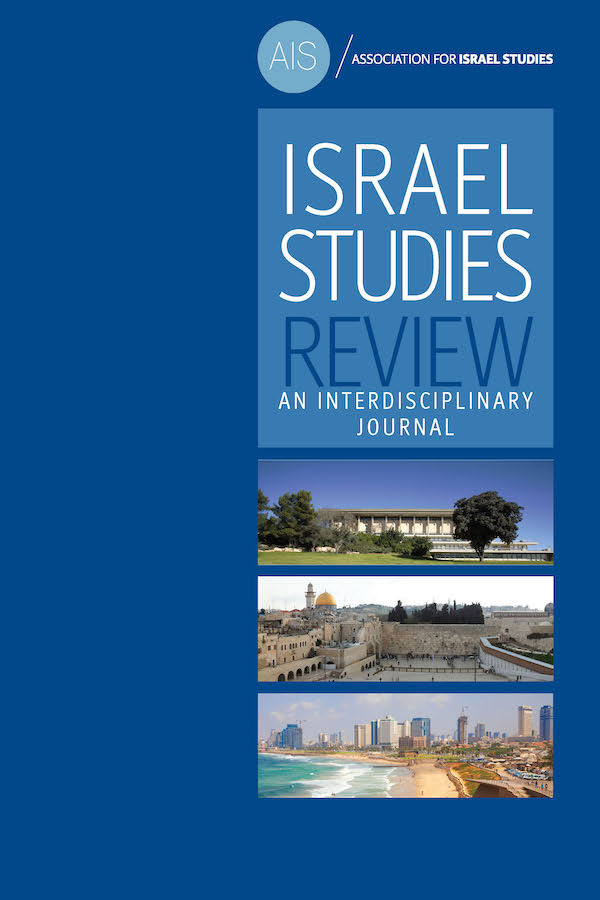
Israel Studies Review
An Interdisciplinary Journal
ISSN: 2159-0370 (print) • ISSN: 2159-0389 (online) • 3 issues per year
Published Open Access as part of the Berghahn Open Society collection.
Editors:
Oded Haklai, Queen's University (Ontario), Canada
Adia Mendelson-Maoz, The Open University of Israel, Israel
Subjects: Israel studies, Middle Eastern studies, Politics
 Available on JSTOR
 Published on behalf of the Association for Israel Studies
AIS Membership includes subscription to this journal.
AIS Members: Access the journal online here.
Latest Issue
Volume 41 Issue 2
House and Home in Mizrahi Theater
Spatial Perspectives
This article examines the relationship between physical space and cultural identity in three Mizrahi theater companies in Israel: the Frechot Ensemble, the Shachar Theatre, and the Dimona Theatre. Drawing on the concepts of ‘house’ and ‘home’, where house denotes the physical theater building and home signifies belonging and community, it explores how these companies negotiate the tension between permanent and temporary performance spaces. Because Mizrahi theater foregrounds ethnic identity and historical narratives often marginalized within mainstream Israeli theater, the presence—or absence—of a permanent venue plays a crucial role in shaping artistic identity and audience engagement. Focusing on companies that operate outside the mainstream and frequently lack the resources to maintain permanent facilities, the article investigates how they cultivate a sense of home within their local communities. It argues that theatrical space is not merely a physical setting but an active component in constructing cultural identity, community belonging, and the social mission of Mizrahi theater.
Performative Returns to Haifa
Rethinking Palestinian Theater in a “Wounded City”
Theatrical events in “adaptive reused buildings” reflect Haifa's history as a “wounded city” and enact a performative return, creating a dual presence of Palestinian urbanism: the ghostly presence of historical victims uprooted from the city and the contemporary community's presence. This article explores three Palestinian theaters in Haifa as case studies: Stage 2 in Wadi Salib, embracing a return to Arabic as a performance language; Al-Midan, representing a civil right to state budgets and thus a return to the city; and Khashabi, an independent theater reclaiming the city and asserting the right to difference for a minority group. This article expands urban performance studies by focusing on the Palestinian minority's theater in Haifa, suggesting that the “performative return” produces knowledge about the ongoing urban wounds and healing processes.
Place-Naming in Jerusalem
Change and Continuity in Israel's Postcolonial Divided Capital
This article argues that since 1949, when Israel declared Jerusalem its capital, this city can best be described as belonging to three overlapping categories―postcolonial cities, divided cities, and capital cities of at least one sovereign state or region―making it a Postcolonial Divided Capital City (PDCC). The article posits that the three main attributes of PDCCs and the interplay among them shape these cities’ political, social, economic, and cultural realms, and that this impact can be discerned in their symbolic landscape and specifically in their toponyms (place-names). The article first discusses the main attributes of PDCCs, their interplay, and their impact. Subsequently, using the illustrative case of Jerusalem, it demonstrates how change and continuity in its characteristics as a PDCC have shaped its symbolic landscape in different periods of its history, with an emphasis on toponyms.
Menachem Begin's Independence Radio Address and the Principles of Israel's Founding
On 15 May 1948, Menachem Begin, commander of the Irgun paramilitary organization, emerged from hiding to deliver a radio address to his followers and the new nation of Israel. In the speech, Begin not only advanced his movement's short-term political aims but also articulated his political credo and vision. Begin's Independence Radio Address is a landmark of Israeli political rhetoric; in it, Begin articulated founding principles for the Jewish state. This article presents a close reading of Begin's speech. Emphasizing aspects that testify to Begin's unique Revisionist Zionist perspective, this article argues that the political theory in the speech strongly overlaps with the political theory expressed by mainstream Zionist leaders in 1948, especially in the Declaration of Independence. The analysis points toward consensus on principles at the time of Israel's founding, which was a significant reason for the durability of the state despite rancorous partisan divisions in the early years.
Through an African American Lens
The Black Press and Palestine, 1947–1949
This article surveys the coverage surrounding the formation of Israel in African American newspapers, published between the passage of United Nations Resolution 181 and the end of the 1948 War. It argues that, instead of embracing a pro-Arab or pro-Israel standpoint, the Black press framed news from Palestine around topics or ideas its readers could identify with. Black editors highlighted the role of Ralph Bunche, the Black American who served as the chief UN Mediator in Palestine. They also drew specific lessons from the Jewish struggle, the Arabs’ alliance, and UN partition deliberations that could be applied to the condition of Black Americans. Whether they supported or criticized Zionism, Black journalists consistently shifted the conversation back to the United States and to themselves.
Team Voting
A Novel Paradigm for Primary Elections to Form the Party List
This article proposes a novel paradigm for primaries for party lists for general elections termed “Team Voting.” Team Voting synthesizes two paradigms typically adopted by political parties in Israel and in other countries using party-list proportional systems: (1) a nomination committee and (2) primaries by voting for individual candidates. This article will outline expectations for this new multiwinner election paradigm vis-à-vis the existing paradigms’ limitations and shortcomings as described in previous research, in particular with respect to the current challenges facing political systems in liberal democracies in general and especially in Israel. A simple model is provided, suggesting Team Voting fosters the election of a diverse list when the selectorate generally favors diversity and pluralism, and a polarized list when the selectorate is generally divisive.
Book Review
GAL, NOAM, The Movers: Israeli Art in the Third Millennium (Toronto: McGill-Queen's University Press, 2025), 192 pp., $44.95.